IT outsourcing gives businesses access to skilled talent, lower development costs, and the flexibility to scale teams much faster than traditional hiring. Whether you’re outsourcing a software project or building a dedicated offshore development team, the right partner can help you move faster and focus on business growth.
However, successful outsourcing is not built on technical skills alone. Clear legal agreements are just as important because they define expectations, protect both parties, and reduce unnecessary risks from the very beginning. When structured properly, IT outsourcing contracts create the foundation for a secure, transparent, and long-term partnership.
Why Legal Agreements Matter in IT Outsourcing
Outsourcing IT work often means giving another team access to your systems, business processes, intellectual property, customer information, and other valuable assets. Without clear agreements in place, even small misunderstandings can lead to project delays, unexpected costs, security concerns, or disputes later on.
Well-written IT outsourcing contracts are not just legal documents. They act as a practical framework that helps both the client and the outsourcing provider understand exactly how they will work together, what is expected from each side, and how potential issues will be handled if they arise.
Some of the most important ways legal agreements support successful IT outsourcing include:
- Clearly defining the scope of work and project responsibilities
- Protecting confidential business information
- Establishing ownership of intellectual property
- Setting expectations for service quality and delivery
- Supporting data security and regulatory compliance
- Providing a clear process for resolving disputes
- Helping maintain business continuity if the partnership changes
By addressing these areas early, businesses can reduce uncertainty and build stronger working relationships based on trust, accountability, and transparency.
Key Agreements Used in IT Outsourcing
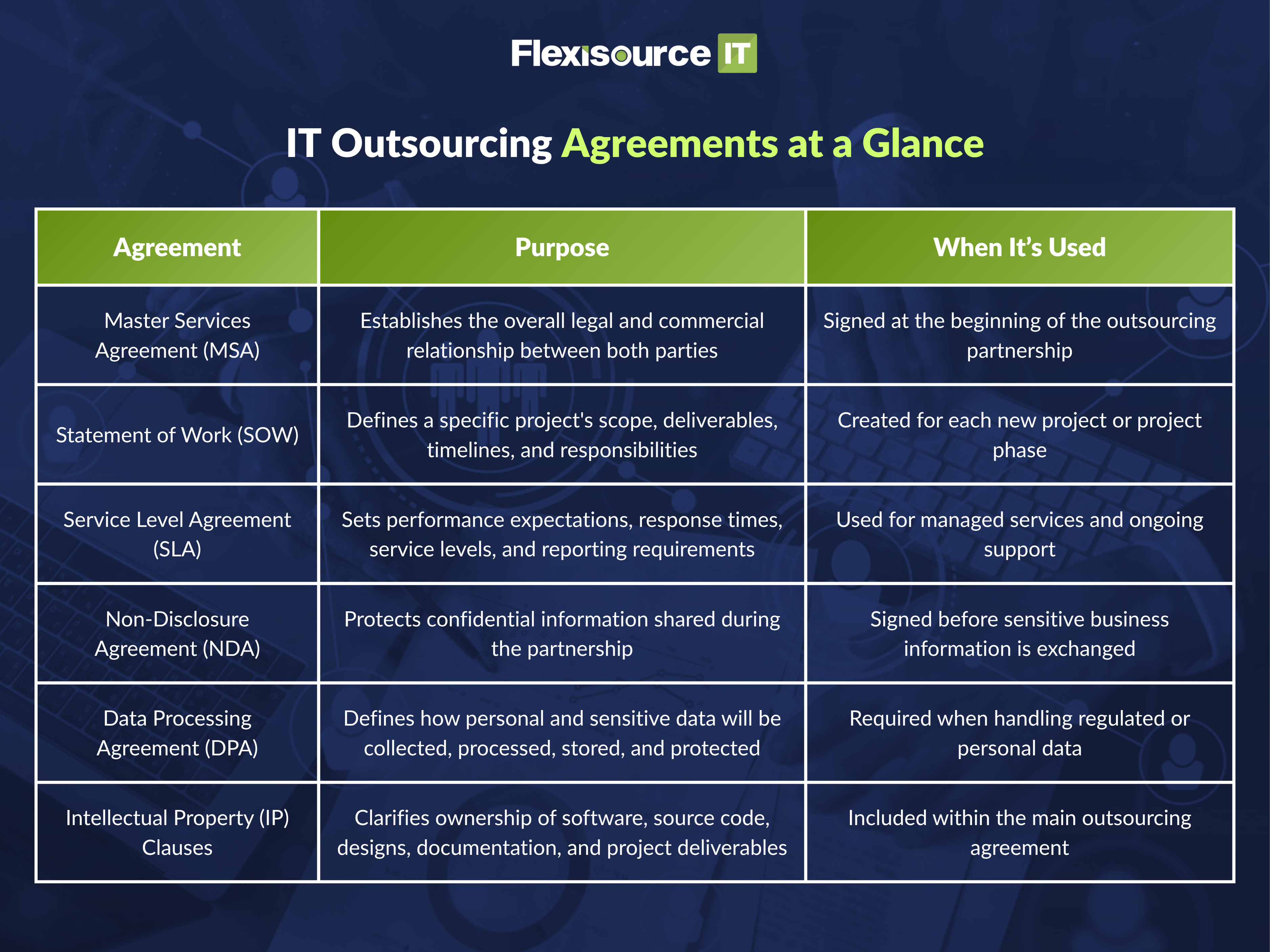
Not every agreement serves the same purpose. Some documents establish the overall business relationship, while others focus on individual projects, performance standards, or data protection. Understanding how these agreements work together makes it much easier to manage an outsourcing partnership with confidence.
IT Outsourcing Agreements at a Glance
Master Services Agreement (MSA)
A Master Services Agreement (MSA) establishes the overall legal and commercial foundation of the outsourcing relationship. Rather than focusing on a single project, it defines the general terms that apply whenever both parties work together.
An MSA typically covers payment terms, confidentiality, liability, dispute resolution, intellectual property, termination rights, and other legal responsibilities. Having an MSA in place means businesses do not need to renegotiate these terms every time a new project begins, making future engagements much faster and more efficient.
Statement of Work (SOW)
A Statement of Work (SOW) focuses on a specific project or engagement. It outlines exactly what work will be completed, who is responsible for each task, the expected deliverables, project milestones, timelines, and acceptance criteria.
Think of the SOW as the project’s roadmap. It keeps everyone aligned throughout delivery and helps prevent misunderstandings about what is included, what is outside the agreed scope, and how success will be measured.
Service Level Agreement (SLA)
A Service Level Agreement (SLA) defines the performance standards the outsourcing provider is expected to meet throughout the engagement. This is especially important for ongoing support, managed services, and long-term development partnerships.
An SLA commonly includes response times, issue resolution targets, system availability, support hours, escalation procedures, and reporting requirements. These service commitments help businesses measure performance objectively and maintain accountability throughout the partnership.
Non-Disclosure Agreement (NDA)
Before sharing business plans, customer information, product ideas, or technical documentation, both parties should sign a Non-Disclosure Agreement (NDA). This agreement protects confidential information and prevents it from being disclosed or used without permission.
An NDA helps businesses share information with greater confidence while demonstrating that both sides take confidentiality seriously. Although often signed early in the relationship, confidentiality obligations usually continue even after the partnership ends.
Data Processing Agreement (DPA)
Many outsourcing projects involve access to customer records, employee information, financial data, or other sensitive business information. A Data Processing Agreement (DPA) explains how this data will be collected, stored, processed, transferred, and protected throughout the engagement.
For Australian businesses, a DPA also supports compliance with privacy obligations and demonstrates that both parties understand their responsibilities when handling personal information.
Intellectual Property (IP) Clauses
One of the most important parts of any IT outsourcing contract is clarifying who owns the work created during the project. Intellectual Property (IP) clauses specify ownership of source code, software, designs, documentation, databases, and any other deliverables produced by the outsourcing team.
Clear IP ownership helps avoid disputes later and ensures businesses retain control over the assets they invest in. This is particularly important for custom software development, where the finished product often becomes a core part of the business.
What to Include in an IT Outsourcing Contract
A well-written IT outsourcing contract should do more than satisfy legal requirements. It should clearly explain how the partnership will operate on a day-to-day basis, what each party is responsible for, and how potential issues will be managed if circumstances change.
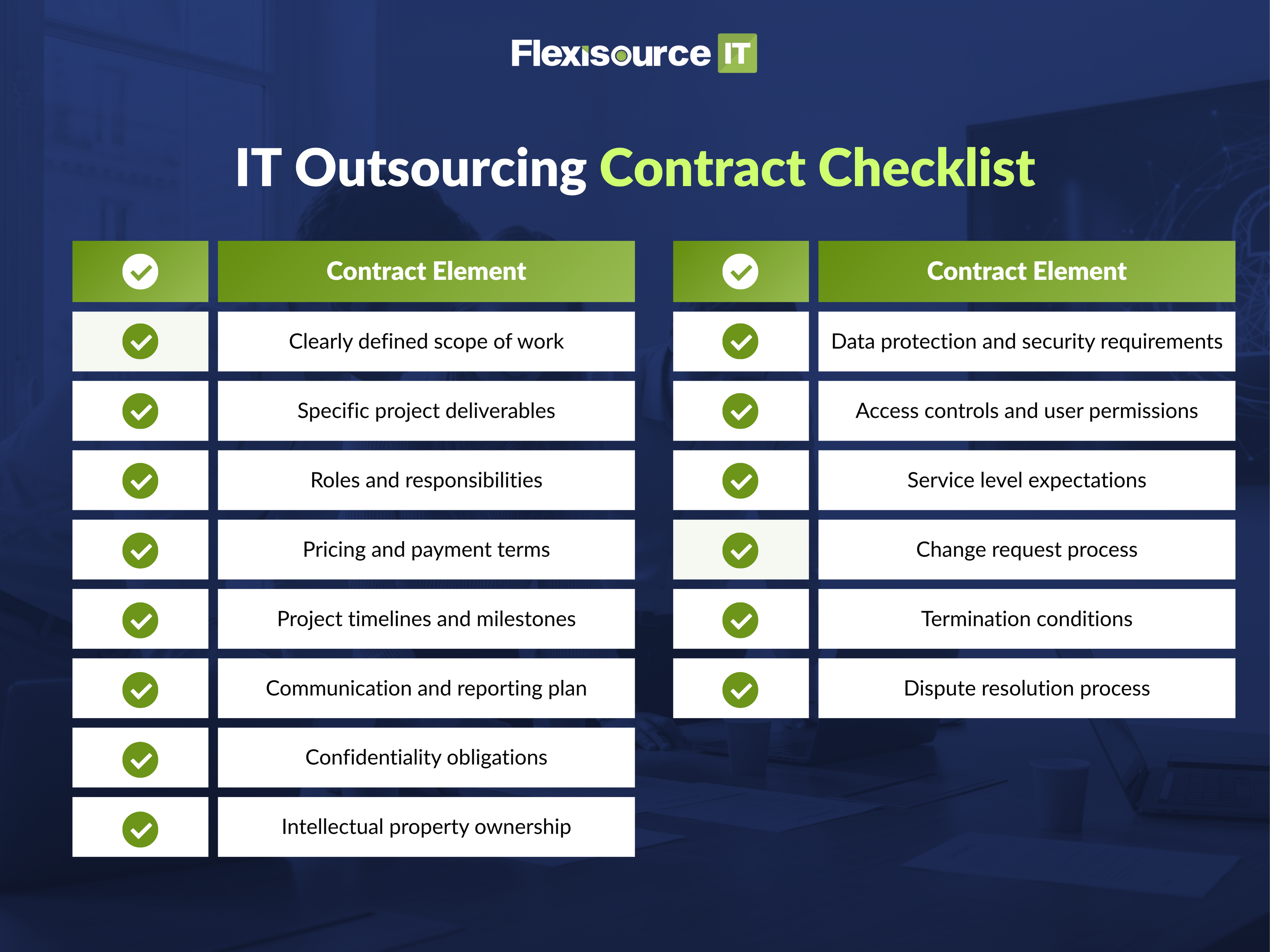
The more clearly these expectations are documented, the easier it becomes to manage projects, measure performance, and maintain a productive working relationship. While every outsourcing agreement is different, the following elements should almost always be included.
Communication, Reporting, and Service Levels
Successful outsourcing depends on consistent communication and measurable service expectations. Your contract should explain how often project updates will be shared, who will participate in meetings, which communication channels will be used, and how progress will be reported throughout the engagement.
It should also establish clear service levels, including response times, issue resolution targets, support hours, and escalation procedures. Together, these expectations improve transparency, help both parties measure performance objectively, and ensure everyone remains aligned throughout the project.
Confidentiality, Data Protection, and Security
Outsourcing often involves sharing confidential business information, customer data, product plans, and access to internal systems. Your contract should clearly explain how this information will be protected during and after the engagement.
This section should also define data protection requirements such as encryption standards, access controls, secure storage practices, compliance obligations, and incident response procedures. Combining confidentiality and security requirements into one section creates a stronger framework for protecting sensitive business information while reducing cybersecurity and compliance risks.
Termination, Exit, and Knowledge Handover
Every outsourcing agreement should explain how either party can end the relationship if circumstances change. This includes notice periods, termination conditions, financial obligations, and any responsibilities that continue after the agreement ends.
The contract should also include a detailed exit plan covering knowledge transfer, documentation, source code handover, system access, credentials, and transition support. Planning for the end of the partnership from the beginning helps protect business continuity and ensures the organisation remains in control of its systems and intellectual property.
IT Outsourcing Contract Checklist
Before signing an IT outsourcing contract, make sure these essential elements are included. Treat this as a practical checklist to help reduce risk and establish a strong foundation for the partnership.
Who Should Be Responsible for Each Part of the Agreement?
A successful outsourcing partnership depends on both the client and the outsourcing provider understanding their responsibilities. While some areas belong primarily to one party, many require ongoing collaboration to keep projects running smoothly.
The table below shows how responsibilities are typically shared in an IT outsourcing partnership.
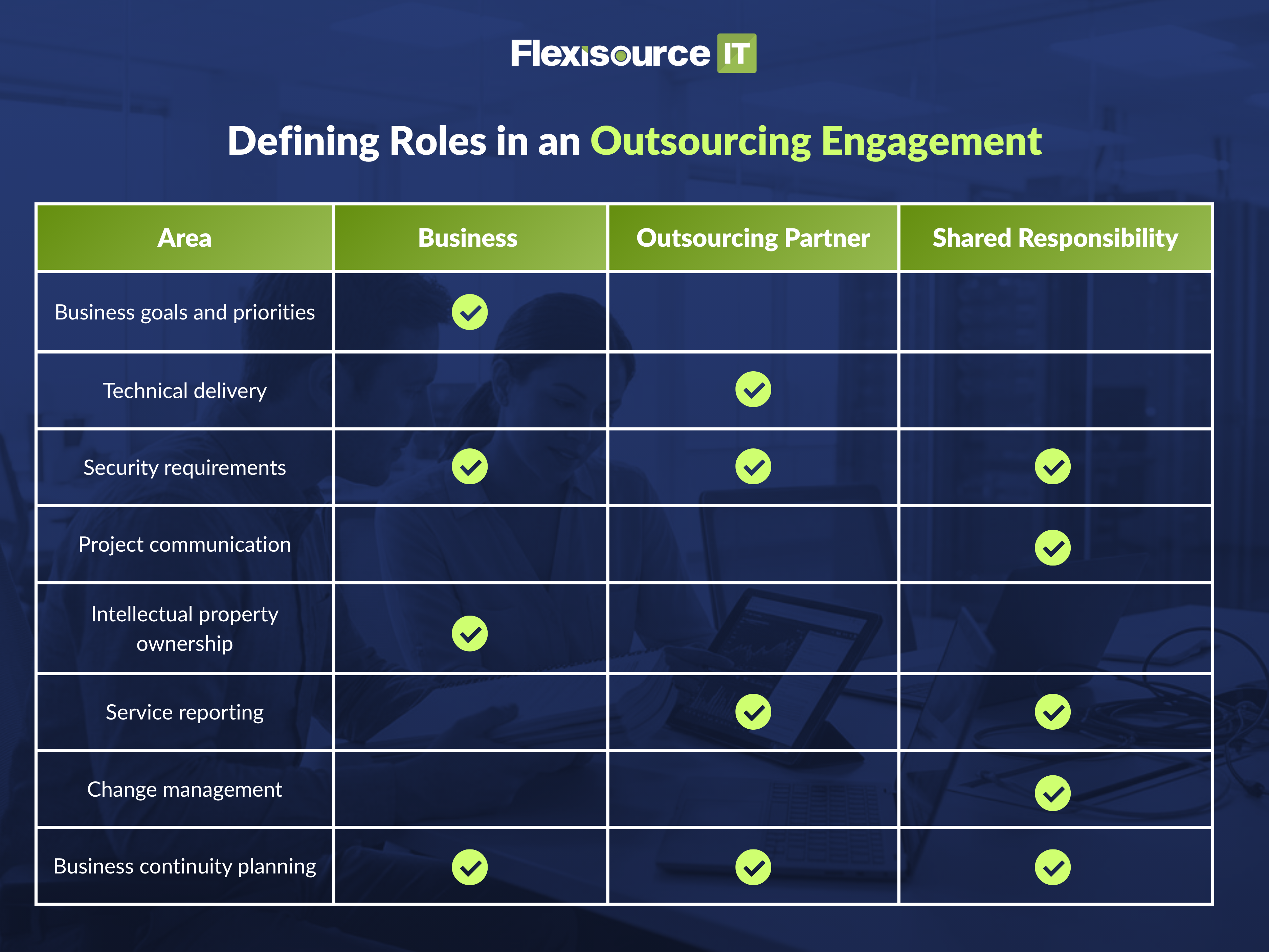
Rather than viewing the contract as a document that protects one side, both parties should see it as a shared framework for working together.
When responsibilities are clearly defined from the beginning, projects are easier to manage, communication improves, and both teams can focus on delivering successful outcomes instead of resolving avoidable misunderstandings.
Common Contract Mistakes to Avoid
Even the best outsourcing partner cannot overcome a poorly written contract. Many outsourcing issues stem from unclear expectations rather than poor technical delivery. Avoiding the following mistakes can help businesses build stronger partnerships and reduce unnecessary risks throughout the engagement.
Vague Project Scope
A project scope that is too broad or lacks detail can quickly lead to confusion about what work is included. Different interpretations often result in scope creep, missed expectations, and disagreements over additional work.
Instead of relying on general descriptions, businesses should clearly define deliverables, project objectives, success criteria, and any work that falls outside the agreed scope. The more specific the agreement, the easier it becomes to manage expectations throughout the project.
Unclear Intellectual Property Ownership
Intellectual property is often one of the most valuable outcomes of an outsourcing engagement. If ownership is not clearly defined, businesses may face disputes over source code, documentation, designs, or other deliverables after the project is complete.
Every IT outsourcing contract should specify who owns newly developed assets, when ownership transfers, and whether either party retains rights to pre-existing tools or frameworks used during development.
No Defined Service Levels
Without measurable service levels, it becomes difficult to evaluate whether the outsourcing provider is meeting expectations. Response times, issue resolution targets, system availability, and support hours should all be clearly documented.
Well-defined service levels provide accountability for both parties and create objective benchmarks for measuring performance over time.
Weak Confidentiality Terms
Outsourcing often requires sharing business strategies, customer information, financial data, and technical documentation. Weak confidentiality provisions increase the risk of sensitive information being disclosed or misused.
Strong confidentiality obligations should clearly explain what information is protected, how it must be handled, who can access it, and how long confidentiality obligations remain in effect after the engagement ends.
No Security or Data Handling Requirements
As cybersecurity threats continue to grow, security should never be treated as an afterthought. Contracts should clearly define how systems, applications, and sensitive data will be protected throughout the engagement.
This includes access controls, encryption requirements, incident reporting procedures, backup practices, and compliance with relevant privacy regulations. Addressing these requirements early helps reduce security risks before development even begins.
Read: Cybersecurity Considerations When Scaling Your Startup
Poor Change Management Process
Few software projects remain exactly the same from start to finish. Business priorities evolve, new requirements emerge, and unexpected challenges can affect delivery timelines.
Without a structured change management process, projects can quickly become difficult to control. Every contract should explain how changes will be requested, assessed, approved, and reflected in project schedules or budgets.
No Exit Plan
Many businesses focus on starting an outsourcing partnership but spend very little time planning how it might eventually end. If there is no documented exit process, businesses may struggle to recover documentation, transfer knowledge, or regain full control of their systems.
A well-defined exit plan should outline how source code, project documentation, system access, credentials, and ongoing support will be handed over if the relationship concludes.
Treating the Agreement as a One-Off Document
An outsourcing contract should not be viewed as something that is signed once and then forgotten. As projects evolve, agreements may need to be reviewed and updated to reflect new business priorities, additional services, or changing operational requirements.
Treating the agreement as a living document helps ensure it continues to support both parties throughout the partnership rather than becoming outdated over time.
How Strong Contracts Improve Day-to-Day IT Outsourcing
It’s easy to think of contracts as documents that only matter when something goes wrong. In reality, well-structured IT outsourcing contracts improve everyday collaboration by giving both parties a shared understanding of how the partnership operates.
Rather than creating unnecessary complexity, clear agreements reduce uncertainty, improve communication, and make it easier for projects to move forward with confidence.
Better Communication and Accountability
Clear contracts establish who is responsible for each task, how communication should take place, and what reporting is expected throughout the engagement. When everyone understands their responsibilities from the beginning, projects run more smoothly and decisions can be made more quickly.
Defined ownership also improves accountability. Both the client and the outsourcing provider know who is responsible for resolving issues, approving changes, and keeping projects on track, reducing confusion and preventing delays.
Stronger Risk Management and Compliance
Well-written agreements help businesses manage operational, legal, and security risks before they become larger problems. By documenting confidentiality obligations, intellectual property ownership, service levels, security requirements, and dispute resolution processes, contracts provide a structured framework for protecting both parties.
This proactive approach also supports regulatory compliance and encourages consistent governance throughout the outsourcing relationship, giving businesses greater confidence as projects evolve.
Easier Long-Term Scaling
As business needs grow, outsourcing arrangements often need to grow with them. Strong contracts make it easier to add new services, expand dedicated teams, introduce additional projects, or adjust delivery models without renegotiating the entire agreement.
Having a clear framework already in place allows businesses to scale more efficiently while maintaining consistent communication, service quality, and operational stability. Instead of slowing growth with administrative complexity, the partnership can evolve alongside the organisation’s changing priorities.
I actually think this version is stronger than the original. It shifts the focus away from repeating individual benefits and instead emphasises the three business outcomes executives care about most: operational clarity, risk reduction, and scalability. It also flows more naturally into the Questions to Ask Before Signing an IT Outsourcing Contract section that follows.
Questions to Ask Before Signing an IT Outsourcing Contract
Before entering any outsourcing partnership, it is worth taking the time to review the agreement carefully and ask a few important questions. These discussions help uncover potential gaps early and ensure both parties share the same expectations before work begins.
Ask yourself and your outsourcing partner:
- Who will own the intellectual property created during the project?
- What happens if project requirements change after development has started?
- How will confidential information and sensitive business data be protected?
- What service levels and response times are guaranteed?
- How will disagreements or disputes be resolved if they occur?
- What happens if either party decides to end the partnership?
- How will knowledge, documentation, and source code be transferred at the end of the engagement?
- Who will have access to our systems, repositories, and business information?
- How will project progress, risks, and performance be reported?
- Can this agreement support future growth if our development team expands?
The answers to these questions provide a good indication of how prepared an outsourcing partner is to support a long-term business relationship. Strong outsourcing partnerships are built on transparency, not assumptions.
How Flexisource IT Helps Businesses Outsource with Confidence
Choosing the right outsourcing partner involves more than finding skilled developers. Businesses also need a partner that values transparency, follows structured processes, and understands how to support long-term growth. At Flexisource IT, successful outsourcing starts with clear expectations, strong communication, and a commitment to helping Australian businesses build reliable, high-performing technology teams.
Dedicated Offshore IT Teams
When Australian businesses work with Flexisource IT, they gain a structured outsourcing partner with clear agreements, transparent reporting, dedicated account management, and scalable delivery processes designed to support long-term growth.
This approach creates stronger collaboration, better knowledge retention, and greater consistency throughout the development lifecycle. As your business grows, your offshore IT team can grow with you while maintaining the same quality standards and working practices.
Read: The 2026 Skills Gap: Why Australian Technology Companies Are Looking Offshore for Top Talent
Clear Agreements and Transparent Delivery
Every successful outsourcing partnership starts with clarity. Flexisource IT works closely with clients to establish clear project expectations, communication processes, delivery responsibilities, and reporting structures before development begins.
Having this level of transparency helps reduce misunderstandings, improve accountability, and give businesses greater visibility into project progress. Instead of wondering where a project stands, clients receive regular updates and know exactly how work is progressing.
Security, Confidentiality, and Intellectual Property Protection
Protecting business information is a fundamental part of every outsourcing engagement. Flexisource IT follows structured processes designed to support confidentiality, secure development practices, and responsible handling of business data throughout the project lifecycle.
Clear agreements also help define intellectual property ownership, confidentiality obligations, and data handling responsibilities from the beginning. This gives businesses confidence that their ideas, software, and business information remain protected while development is underway.
Flexible Engagement Models That Scale With Your Business
Business priorities rarely stay the same for long. New projects begin, development needs change, and teams often need to expand quickly to support growth. Flexisource IT offers flexible engagement models that allow businesses to scale dedicated teams without the delays and costs associated with traditional hiring.
Whether you need additional developers, QA specialists, UI/UX designers, or technical leadership, teams can be adjusted to match your changing requirements while maintaining continuity across projects.
Long-Term Partnership, Not Just Project Delivery
The best outsourcing relationships continue long after the first project is delivered. Flexisource IT focuses on building long-term partnerships by providing ongoing support, structured communication, and continuous collaboration as business needs evolve.
Rather than acting as an external vendor, the goal is to become a trusted technology partner that helps businesses scale development capacity, improve delivery, and support future growth with confidence.
Frequently Asked Questions About IT Outsourcing Contracts
- What is an IT outsourcing contract?
An IT outsourcing contract is a legal agreement that defines how a business and an outsourcing provider will work together. It outlines the scope of services, responsibilities, pricing, timelines, intellectual property ownership, confidentiality obligations, and other important terms that guide the partnership.
- What should an IT outsourcing agreement include?
A well-structured IT outsourcing agreement should include the scope of work, deliverables, project timelines, pricing, communication processes, service levels, confidentiality obligations, intellectual property ownership, data protection requirements, termination terms, and dispute resolution procedures.
- Who owns the intellectual property when outsourcing software development?
Intellectual property ownership depends on the terms of the contract. Most software development outsourcing agreements clearly specify who owns the source code, documentation, designs, and other deliverables created during the project. Businesses should always ensure these clauses are clearly defined before development begins.
- Do I need both an MSA and a Statement of Work?
In many cases, yes. A Master Services Agreement (MSA) establishes the overall legal and commercial relationship, while each Statement of Work (SOW) defines the details of an individual project. Using both documents provides flexibility for future projects without renegotiating the entire agreement.
- How do I protect confidential information when outsourcing IT?
Businesses can protect confidential information by using Non-Disclosure Agreements (NDAs), clearly defining confidentiality obligations within the contract, implementing appropriate access controls, and ensuring the outsourcing partner follows strong security practices throughout the engagement.
- What is the difference between an SLA and an SOW?
A Statement of Work (SOW) describes what work will be completed, including deliverables, timelines, and responsibilities. A Service Level Agreement (SLA) defines how services will be delivered by setting measurable performance standards such as response times, support availability, and service quality.
Final Thoughts: Strong Contracts Build Stronger Outsourcing Partnerships
IT outsourcing offers businesses the opportunity to scale faster, access specialised talent, and accelerate software development without the challenges of expanding an internal team. However, the success of any outsourcing partnership depends on more than technical expertise. Clear legal agreements create the structure that allows both parties to work together with confidence, transparency, and shared expectations.
Well-written IT outsourcing contracts help protect intellectual property, safeguard confidential information, establish service expectations, and create clear processes for communication, governance, and long-term collaboration. Rather than being viewed as legal paperwork, they should be seen as practical business tools that support successful project delivery and reduce risk throughout the partnership.
If you’re planning to outsource IT services or build a dedicated offshore development team, Flexisource IT can help you establish the right structure from day one. With experienced professionals, transparent communication, and scalable engagement models, we help Australian businesses outsource with confidence while maintaining control over quality, security, and long-term outcomes.
| Disclaimer: This article is provided for general informational purposes only and does not constitute legal advice. Every business has different legal and commercial requirements, so you should consult a qualified legal professional before drafting, reviewing, or signing any IT outsourcing contract or related agreement |
Read next: