It’s 2026, and hiring in general isn’t what it used to be.
You don’t always need to go through long hiring processes just to get a project moving.
Sometimes, bringing in the right people at the right time is enough. That’s where understanding the different types of staff augmentation really helps, especially if you want to stay flexible and move faster.
What Is Staff Augmentation?
Staff augmentation is a hiring approach where businesses bring in external professionals to support their existing team. Instead of outsourcing entire projects, companies add skilled people to fill gaps, speed up work, or handle specific tasks.
How Staff Augmentation Works
Instead of hiring full-time employees right away, you bring in extra people only when you actually need them. They work with your team, follow your processes, and help you move things forward without slowing down your current workflow.
It’s like adding more hands to the team without going through long hiring steps. Many businesses use different types of staff augmentation to stay flexible and keep projects moving without overcommitting.
Why Do Businesses Use Staff Augmentation Today?
Hiring today takes time, and not every role needs to be permanent. Staff augmentation gives businesses a way to bring in skilled people quickly, without locking into long-term contracts.
It also helps when projects suddenly grow or timelines get tighter. That’s why more companies are using different types of staff augmentation to stay flexible, control costs, and avoid hiring bottlenecks.
Staff Augmentation vs. Outsourcing vs. In-House Hiring
Staff augmentation keeps everything within your control, since the added team members work directly with you. Outsourcing, on the other hand, hands over the work to another company, while in-house hiring means building your own team from the ground up.
Each approach has its place, depending on what you need. Most businesses now mix these options and use different types of staff augmentation when they need speed, flexibility, or extra support without long-term commitment.
| Factor | Staff Augmentation | Outsourcing | In-House Hiring |
| Control | You manage the team directly | Vendor manages the work | Full internal control |
| Flexibility | High – scale up or down anytime | Medium – depends on contract | Low – fixed team size |
| Speed to Start | Fast – talent can join quickly | Medium – setup takes time | Slow – long hiring process |
| Cost Structure | Pay only for what you need | Fixed or project-based | High fixed costs (salary, benefits) |
| Team Integration | Works as part of your team | Separate external team | Fully integrated |
| Best For | Filling skill gaps, scaling fast | Full project delivery | Long-term internal growth |
| Risk Level | Lower – flexible engagement | Medium – depends on vendor | Higher – long-term commitment |
How to Choose the Right Type of Staff Augmentation for Your Business
Choosing between different types of staff augmentation can feel confusing at first. Each option affects cost, speed, and how your team works day to day. Instead of picking randomly, it helps to focus on what your business actually needs and how quickly you need results.
Start With Your Actual Business Problem (Not the Model)
Before choosing from the types of staff augmentation, ask what problem you are solving.
Are you short on developers?
Do you need faster delivery?
When the problem is clear, the right model becomes easier to identify.
How Cost, Speed, and Scalability Really Affect Your Choice
Some types of staff augmentation are cheaper but slower, while others are faster but cost more.
Balancing these factors helps you choose a model that fits both your budget and timeline.
What Happens When You Pick the Wrong Staff Augmentation Model
Choosing the wrong model can slow everything down. You might end up with the wrong skill level, poor communication, or a setup that doesn’t fit how your team actually works.
For example, hiring offshore without proper overlap can delay decisions, while choosing short-term support for a long-term need can create constant turnover. Understanding the different types of staff augmentation helps you avoid these problems and set your team up for smoother, more consistent results.
Read: Offshore Developers vs In-House Developers: Pros and Cons
Types of Staff Augmentation by Geographical Location
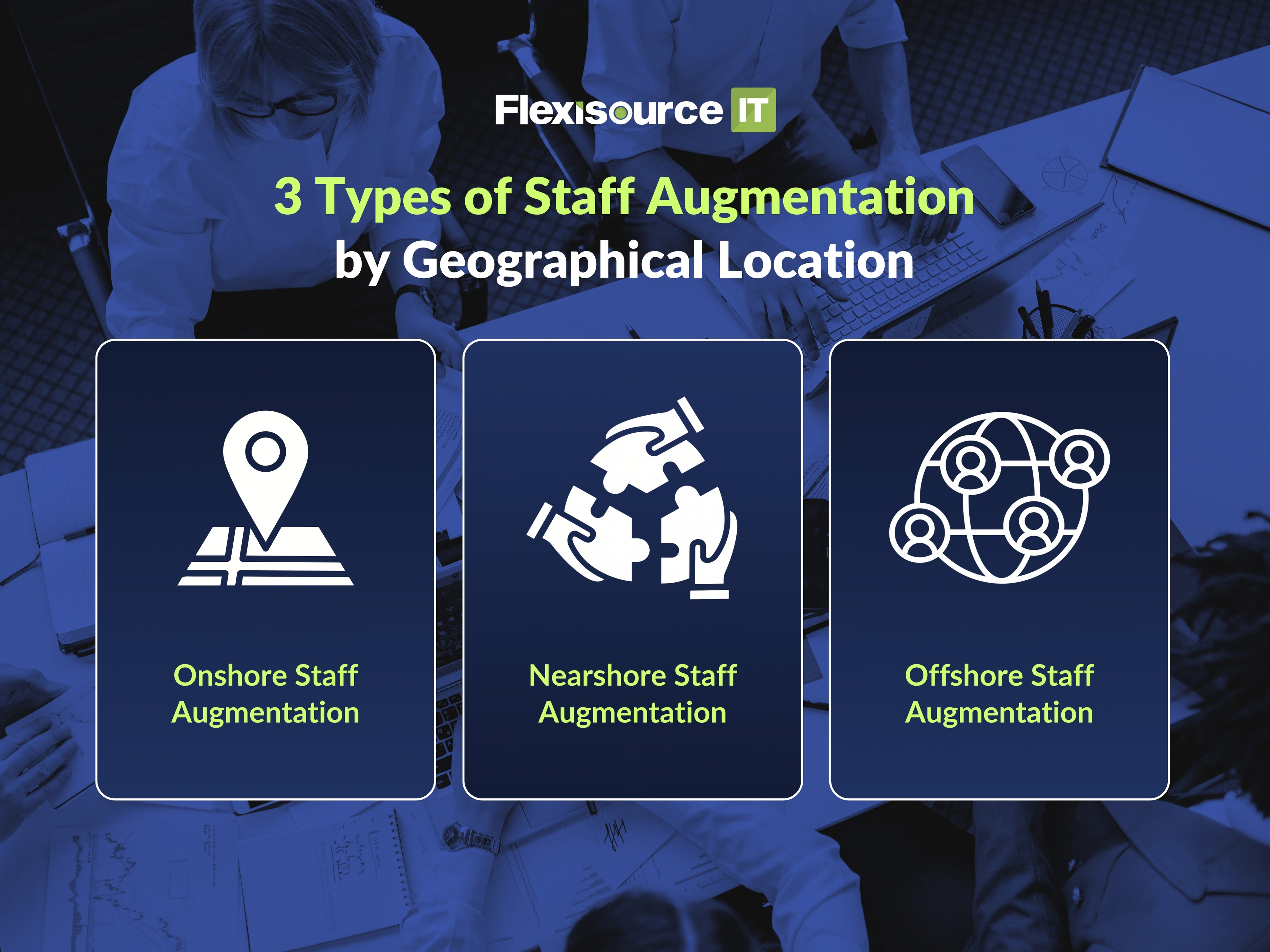
One of the most common ways to break down the types of staff augmentation is by location. Where your team is based affects cost, communication, and collaboration.
Onshore Staff Augmentation
Onshore staff augmentation means hiring talent within your own country. It’s the easiest setup because communication is simple, and there are no time zone gaps to manage. Teams can talk, decide, and move quickly without adjusting schedules.
The downside is cost. Local hiring is usually the most expensive option, which can make it harder to scale or build larger teams when needed.
Pros:
- Real-time communication with no time zone delays
- Easier collaboration and team alignment
- Better understanding of local business context
Cons:
- Higher costs (salary, benefits, overhead)
- Limited access to a wider talent pool
- Slower scaling due to local hiring constraints
Nearshore Staff Augmentation
Nearshore staff augmentation means working with talent from nearby countries. You still get some time overlap, which helps with communication, but at a lower cost than hiring locally.
This works well for businesses that want a balance. You save money while still keeping collaboration fairly smooth and manageable.
Pros:
- Partial time zone overlap for easier collaboration
- Lower cost compared to onshore hiring
- Access to a broader regional talent pool
Cons:
- Still more expensive than offshore options
- Limited scalability compared to global hiring
- Possible minor cultural or workflow differences
Offshore Staff Augmentation
Offshore staff augmentation means hiring talent from countries further away, like the Philippines. This gives you access to a much wider talent pool at a lower cost, which is why many businesses choose this model.
The setup matters here. With the right structure and some overlapping hours, collaboration can still feel easy. Flexisource IT helps Australian businesses make this work by aligning offshore teams with local schedules.
Pros:
- Significantly lower cost compared to local hiring
- Access to global talent and specialised skills
- High scalability for growing teams
Cons:
- Time zone differences need to be managed properly
- Requires structured communication processes
- Initial setup may take some adjustment
Which Location Model Is Best for Your Business?
There’s no single answer here.
It depends on what matters most to you right now. If you want the easiest communication, onshore is the simplest option. If you want to scale faster and reduce costs, offshore is usually the better choice.
A lot of businesses combine these approaches. They keep key roles local and use offshore teams for execution, which gives them both control and flexibility at the same time.
Types of Staff Augmentation by Skill Level
Another way to understand the types of staff augmentation is by skill level. Not all roles require the same expertise.
Commodity-Based Staff Augmentation
Commodity-based staff augmentation focuses on roles that are repetitive and process-driven, such as data entry, basic QA testing, or administrative support tasks. These roles follow clear instructions and do not usually require complex decision-making.
Pros:
- Lower cost compared to other types of staff augmentation
- Easy to scale quickly for high-volume work
- Frees up your core team from repetitive tasks
Cons:
- Limited ability to handle complex or strategic work
- May require supervision or clear instructions
- Output quality depends heavily on process clarity
When to use this:
- When you have repetitive, high-volume tasks
- When speed and cost matter more than expertise
- When your internal team is overloaded with routine work
When this may not be the right fit:
- When tasks require critical thinking or problem-solving
- When work involves decision-making or ownership
- When quality and precision are more important than speed
Example:
A business processing large volumes of customer data might use commodity-based staff augmentation for data entry, while keeping analysis and reporting tasks with experienced team members.
Biggest risk:
Using low-skill roles for tasks that actually need experience can lead to mistakes, rework, and slower overall progress.
Best fit:
Best for handling repetitive work at scale while keeping costs low.
Skill-Based Staff Augmentation
Skill-based staff augmentation involves professionals with practical experience, such as developers, designers, or analysts who can handle structured and meaningful work without constant supervision.
Pros:
- Balanced cost and capability
- Can handle real project work independently
- Faster onboarding compared to junior roles
Cons:
- May still require guidance for complex tasks
- Skill levels can vary between candidates
When to use this:
- When you need reliable execution for core tasks
- When your internal team needs support, not replacement
- When projects require consistent output
When this may not be the right fit:
- When tasks are highly specialised or strategic
- When senior-level decision-making is required
Example:
A company building a web platform may use skill-based developers to handle feature development while senior engineers manage architecture.
Biggest risk:
Hiring mid-level talent for work that actually needs senior expertise can lead to delays or rework.
Best fit:
Best for day-to-day execution and ongoing project support.
Highly Skilled Staff Augmentation
Highly skilled staff augmentation focuses on senior professionals and specialists who can handle complex systems, critical decisions, and high-impact work.
Pros:
- Deep expertise and problem-solving ability
- Can handle complex or high-risk projects
- Requires minimal supervision
Cons:
- Higher cost compared to other types of staff augmentation
- Limited availability for niche skills
When to use this:
- When working on complex or technical projects
- When your team lacks specialised expertise
- When quality and precision are critical
When this may not be the right fit:
- When tasks are repetitive or low complexity
- When budget is limited for high-level roles
Example:
A business implementing AI solutions may hire a senior AI engineer to design the system while other team members handle execution.
Biggest risk:
Using senior talent for simple tasks can lead to unnecessary costs without added value.
Best fit:
Best for high-impact work that requires expertise and decision-making.
How to Match Skill Level With Project Complexity
Not every task needs a senior expert, and not every project can rely on basic support. Matching the right skill level to the actual work is what makes staff augmentation effective.
Simple tasks can be handled by commodity roles, while more complex systems need experienced professionals. Understanding the different types of staff augmentation helps you avoid overspending while still getting the results you need.
Types of Staff Augmentation by Engagement Model
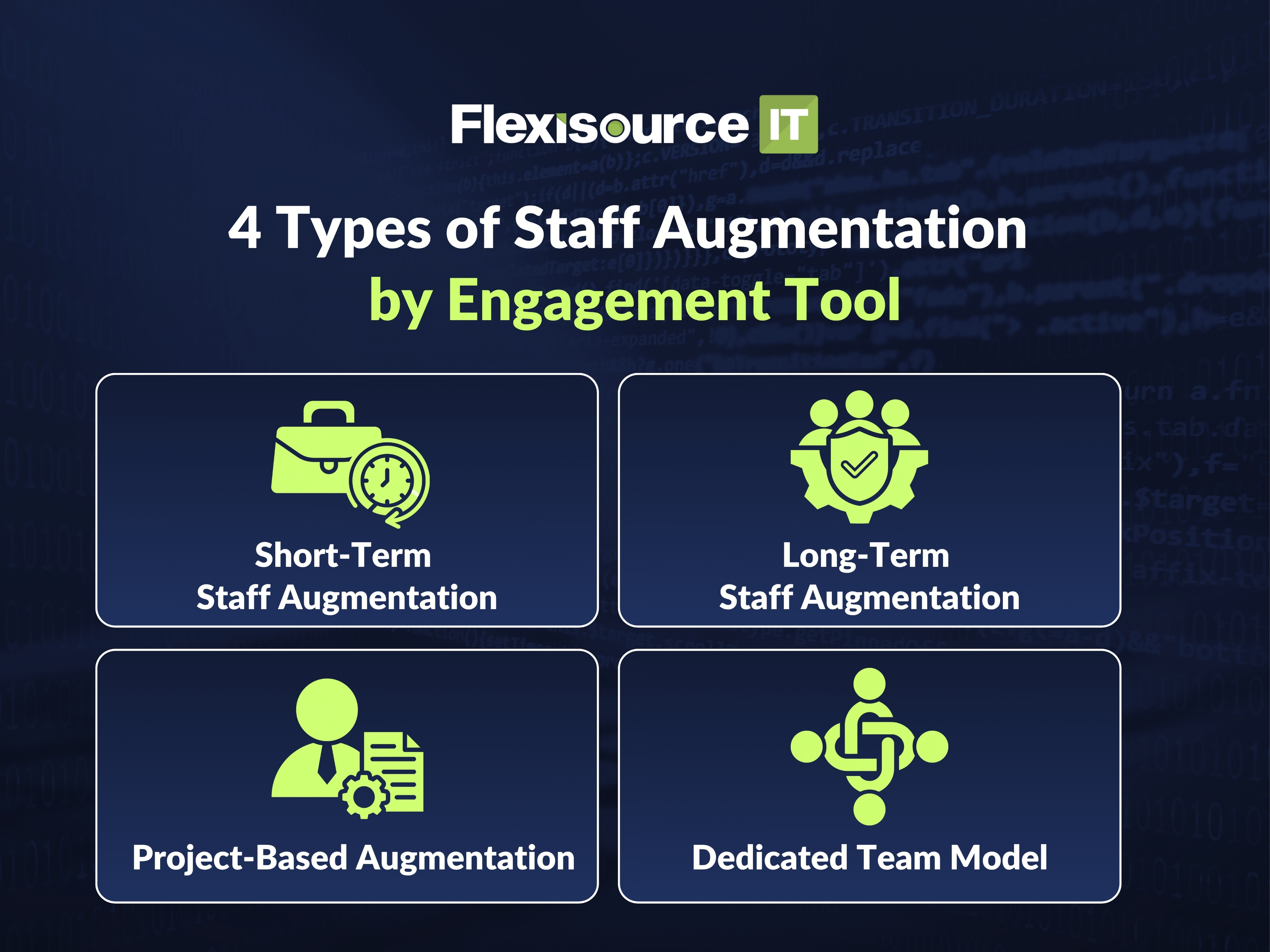
Not all projects need the same level of commitment. Some need quick support, while others need long-term collaboration. That’s why understanding these types of staff augmentation is important. The right engagement model affects how your team works, how costs are managed, and how smoothly everything runs day to day.
Short-Term Staff Augmentation
Short-term staff augmentation is used when you need help for a limited time. This could be for a quick project, a sudden workload increase, or a temporary gap in your team. It’s a fast way to bring in support without long-term commitment. Many businesses use this type when they need quick results without adding permanent staff.
Long-Term Staff Augmentation
Long-term staff augmentation is better for ongoing work or extended projects. These team members stay longer and become more familiar with your systems and processes. Over time, they start to feel like part of your core team. This model works well when you need consistent support and stability.
Project-Based Augmentation
Project-based augmentation focuses on delivering a specific outcome. You bring in people to complete a defined task or project, and once it’s done, the engagement ends. This works best when the scope is clear. It’s one of the more structured types of staff augmentation, especially for businesses that want predictable results.
Dedicated Team Model
The dedicated team model gives you a group of professionals who work closely with your business on an ongoing basis. They follow your workflow, use your tools, and align with your goals.
Flexisource IT often supports this model by building offshore teams that integrate directly with Australian businesses, making collaboration feel seamless.
Which Engagement Model Should You Choose?
The right choice depends on how long you need support and how involved the team needs to be. If you need quick help, short-term works well. If you want consistency, long-term or dedicated teams are better.
Understanding these types of staff augmentation helps you choose a model that fits your workflow, not the other way around.
Types of Staff Augmentation by Pricing Model
Pricing is another key factor when comparing the types of staff augmentation. Each model affects how you manage costs and resources over time. Understanding these options helps businesses stay within budget while still getting the right level of support and flexibility.
Hourly Rate Model
You pay based on hours worked.
This works well when your workload changes often, but costs can add up quickly if tasks are not clearly tracked or managed properly.
Monthly Retainer Model
You pay a fixed monthly fee.
This makes budgeting easier and works best when you need ongoing support, since you always have a consistent team available without renegotiating terms each time.
Project-Based Pricing
You pay for the full project.
This is ideal when the scope, timeline, and deliverables are clearly defined, as it reduces uncertainty and keeps both cost and expectations predictable.
Performance-Based Pricing
Payment is based on results or outcomes.
This can be useful for goal-driven projects, but it requires clear metrics and agreement upfront to avoid confusion around what counts as success.
How to Choose the Right Pricing Model
Choose hourly for flexibility, monthly for stability, and project-based for clear tasks. The best choice depends on how predictable your workload is, how much control you want over costs, and how clearly your project requirements are defined.
What Businesses Actually Gain From Using Staff Augmentation
Businesses are not just choosing staff augmentation because it is trendy. They use it because it solves real problems. The different types of staff augmentation help companies move faster, reduce hiring pressure, and stay flexible without sacrificing quality or control.
Hiring Faster Without Getting Stuck in Long Recruitment Cycles
Staff augmentation allows businesses to skip long hiring processes that usually involve sourcing, interviews, and onboarding delays. Instead of waiting months to fill a role, companies can bring in experienced talent quickly and start making progress almost immediately, which is especially helpful when timelines are tight or projects need to move fast.
Tapping Into Global Talent Without Expanding Locally
You are not limited to your local talent pool when using staff augmentation, which opens up access to a much wider range of skills and experience. Access to global professionals makes it easier to find the right people for specific roles, especially when local hiring options are limited or when specialised expertise is hard to find nearby.
Reducing Costs Without Locking Into Long-Term Commitments
You only pay for the support you actually need, rather than committing to full-time salaries, benefits, and long-term contracts. Lower overhead and flexible engagement make it easier to manage budgets while still getting the work done, especially for projects that do not require permanent hires or ongoing roles.
Scaling Your Team Up or Down Without Disrupting Operations
You can adjust your team size based on your current workload, whether that means adding more people during busy periods or scaling back when things slow down. Greater flexibility allows businesses to stay efficient without overstaffing or under-resourcing, helping operations run more smoothly even as demands change.
How Flexisource IT Supports Staff Augmentation
Flexisource IT helps businesses use the right types of staff augmentation without the usual challenges. Instead of handling everything yourself, you get structured support, pre-vetted talent, and teams that align with your workflow, making it easier to scale and manage projects efficiently.
Access to Pre-Vetted Offshore Talent
Flexisource IT gives you access to offshore professionals who are already screened for both technical skills and real-world experience.
Instead of spending time reviewing resumes and running multiple interviews, businesses can start working with capable talent right away, which helps reduce hiring delays and ensures projects move forward without unnecessary setbacks.
Teams Aligned With Australian Business Hours
Flexisource IT builds offshore teams that work closely with Australian business hours, making communication feel more natural and consistent. With only a small time difference, teams can collaborate in real time, join meetings without difficulty, and respond quickly to updates, which makes day-to-day work much smoother.
Flexible Engagement and Pricing Models
Flexisource IT offers different engagement and pricing options so businesses can choose what fits their needs instead of adjusting to a fixed structure.
Whether the goal is short-term support or long-term collaboration, having flexible options makes it easier to manage costs, scale teams when needed, and avoid being locked into arrangements that no longer make sense.
End-to-End Support and Remote Team Management
Flexisource IT supports the entire process, from sourcing talent to onboarding and ongoing team management, so businesses do not have to handle everything on their own. Having structured support in place helps keep teams organised, improves communication, and ensures that projects stay on track, even as requirements change over time.
Frequently Asked Questions About Types of Staff Augmentation
- What are the types of staff augmentation?
They include models based on location, skill level, engagement, and pricing.
- Which staff augmentation model is best?
It depends on your budget, timeline, and project needs.
- Is offshore staff augmentation reliable?
Yes, especially with trusted providers like Flexisource IT.
- How much does staff augmentation cost?
Costs vary depending on location, skill level, and pricing model.
- When should you use staff augmentation?
When you need to scale quickly, reduce costs, or access specialised skills.
Final Thoughts: Choosing the Right Staff Augmentation Model
Understanding the different types of staff augmentation helps you make smarter hiring decisions. Instead of guessing, you can choose a model that fits your business, your budget, and your timeline.
If you want to build the right team without the stress of traditional hiring, Flexisource IT can help. Contact us today and let’s find the best staff augmentation solution for your business.