
Your software architecture and repository structure can determine how easily you outsource development, divide work between teams and scale engineering capacity. A monorepo can simplify shared-code changes and collaboration, while microservices can allow teams to develop and deploy different parts of an application independently.
However, monorepos and microservices are not competing architectures. A monorepo describes where code is stored, while microservices describe how an application is structured. You can use both together.
For businesses looking to outsource software development in Australia, the important question is whether your technical setup allows offshore developers to work effectively without creating unnecessary dependencies, security risks or delivery bottlenecks.
At Flexisource IT, we help Australian businesses build offshore software development teams that work with their existing technology, processes and delivery requirements.
Monorepo vs Microservices: What Is the Actual Difference?
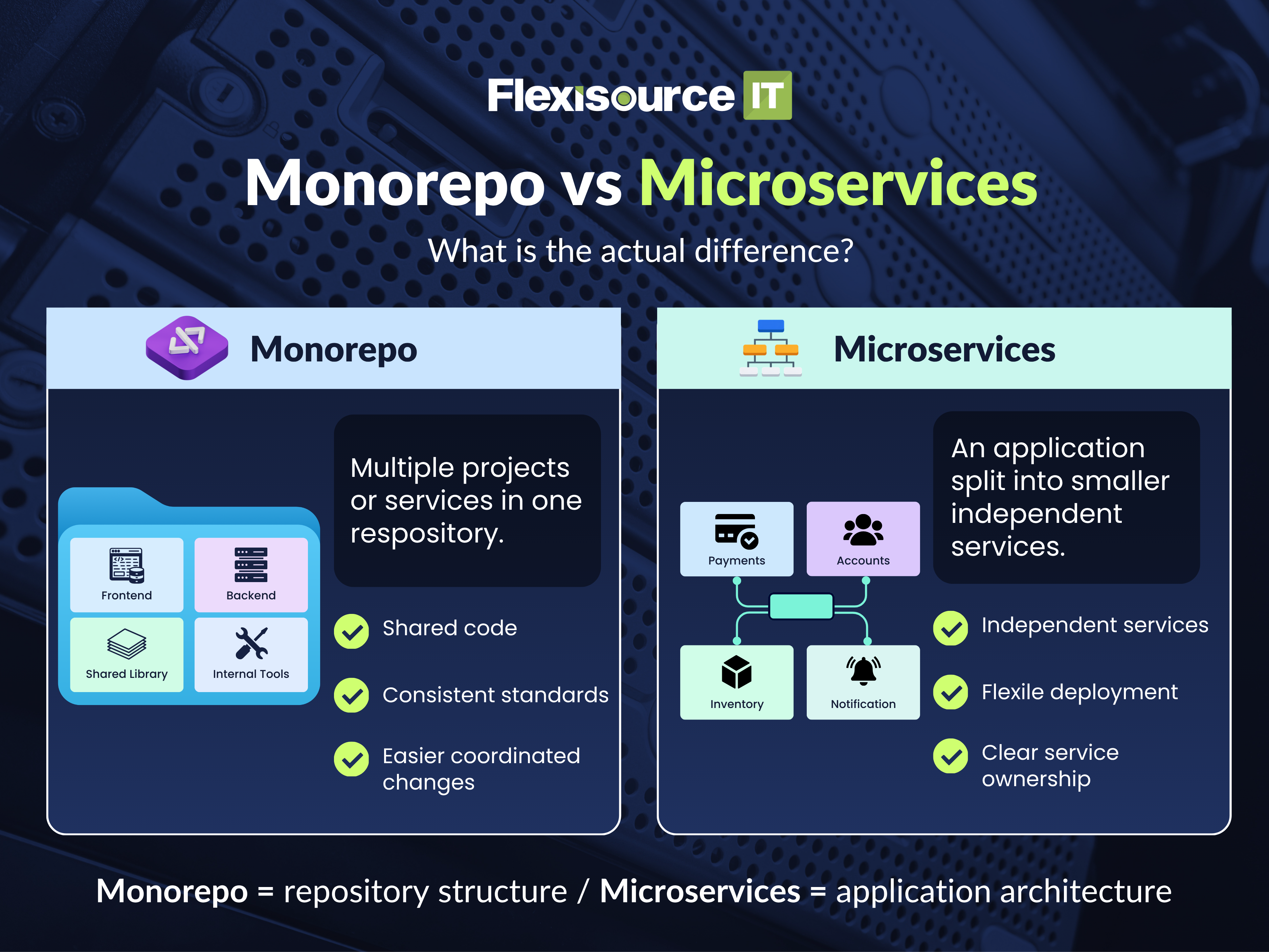
The difference between a monorepo and microservices comes down to repository management versus application design. Both can influence development workflows, but they solve different problems.
Understanding this distinction matters before outsourcing because repository structure affects code access and collaboration, while application architecture affects ownership, deployment and integration.
What Is a Monorepo?
A monorepo is a software development approach where multiple projects, applications or services are maintained in a single repository.
For example, a business might store its customer portal, backend services, shared libraries and internal tools in one repository. This gives developers a central place to find related code and coordinate changes.
A monorepo can offer several advantages:
- Easier sharing of code and development tools
- Consistent coding standards across projects
- Better visibility into dependencies
- Simpler coordination of changes affecting multiple applications
However, larger repositories can also create challenges with build performance, merge conflicts and access management. Microsoft’s Azure Architecture Center identifies these trade-offs when comparing monorepos with multiple repositories.
What Are Microservices?
Microservices are an architectural approach where an application is divided into smaller services organised around specific business capabilities.
For example, an ecommerce platform might have separate services for payments, notifications, customer accounts and inventory. Each service has a defined responsibility and can potentially be developed, tested and deployed independently. This structure can make it easier to assign different services to different engineering teams.
However, microservices also introduce operational complexity. Teams must manage service communication, API compatibility, monitoring, infrastructure and integration testing.
According to Microsoft’s microservices guidance, these responsibilities require careful planning and mature engineering practices.
Can You Use Microservices in a Monorepo?
Yes. Microservices can exist within a monorepo. Multiple independently deployable services can share one repository while maintaining separate build pipelines, testing requirements and deployment processes. This means businesses do not necessarily need to choose one approach over the other.
The better decision is to determine which repository structure supports the application’s architecture and how different engineering teams need to collaborate.
How Software Architecture Shapes Your Outsourcing Options
Architecture affects more than code organisation. It influences how quickly offshore developers can become productive, how much work they can complete independently and how closely they need to coordinate with internal engineers.
For custom software development outsourcing, these considerations should influence the engagement model before additional developers join the project.
Shared Repositories Make Cross-Team Collaboration Easier
A monorepo can be useful when internal and offshore developers frequently work on related parts of an application.
For example, a new feature may require changes to frontend components, backend logic and shared libraries. Keeping these projects in one repository can make dependencies more visible and help teams coordinate updates.
However, shared access requires clear ownership. Teams should define who reviews changes, who approves updates to shared components and which testing requirements apply before merging code.
Microservices Can Give Offshore Teams Clearer Ownership
Microservices can work well when offshore developers are responsible for a clearly defined business capability.
An offshore team might own a reporting service while an internal team manages payments and customer authentication. With stable APIs, clear requirements and independent deployment processes, both teams can make progress without coordinating every implementation detail.
AWS describes a service-per-team pattern where teams own specific business capabilities and coordinate primarily through agreed APIs. However, independence depends on how services are designed. If every change requires updates across several services, the architecture may create more coordination work rather than less.
Architecture Determines How Much Coordination You Need
Adding offshore developers does not automatically increase delivery speed. If responsibilities overlap, dependencies are unclear or releases require constant approval from another team, additional capacity may have limited impact.
More Developers Don’t Automatically Mean Faster Delivery
Before expanding, engineering leaders should identify which work can be completed independently and which changes require shared planning. Clear ownership, documented interfaces and reliable testing processes often matter more than the number of repositories or services.
Monorepo, Microservices or Both? Comparing Outsourcing Flexibility
The right technical setup depends on how much independence your outsourced team needs, how frequently developers share code and how much operational complexity your business can manage.
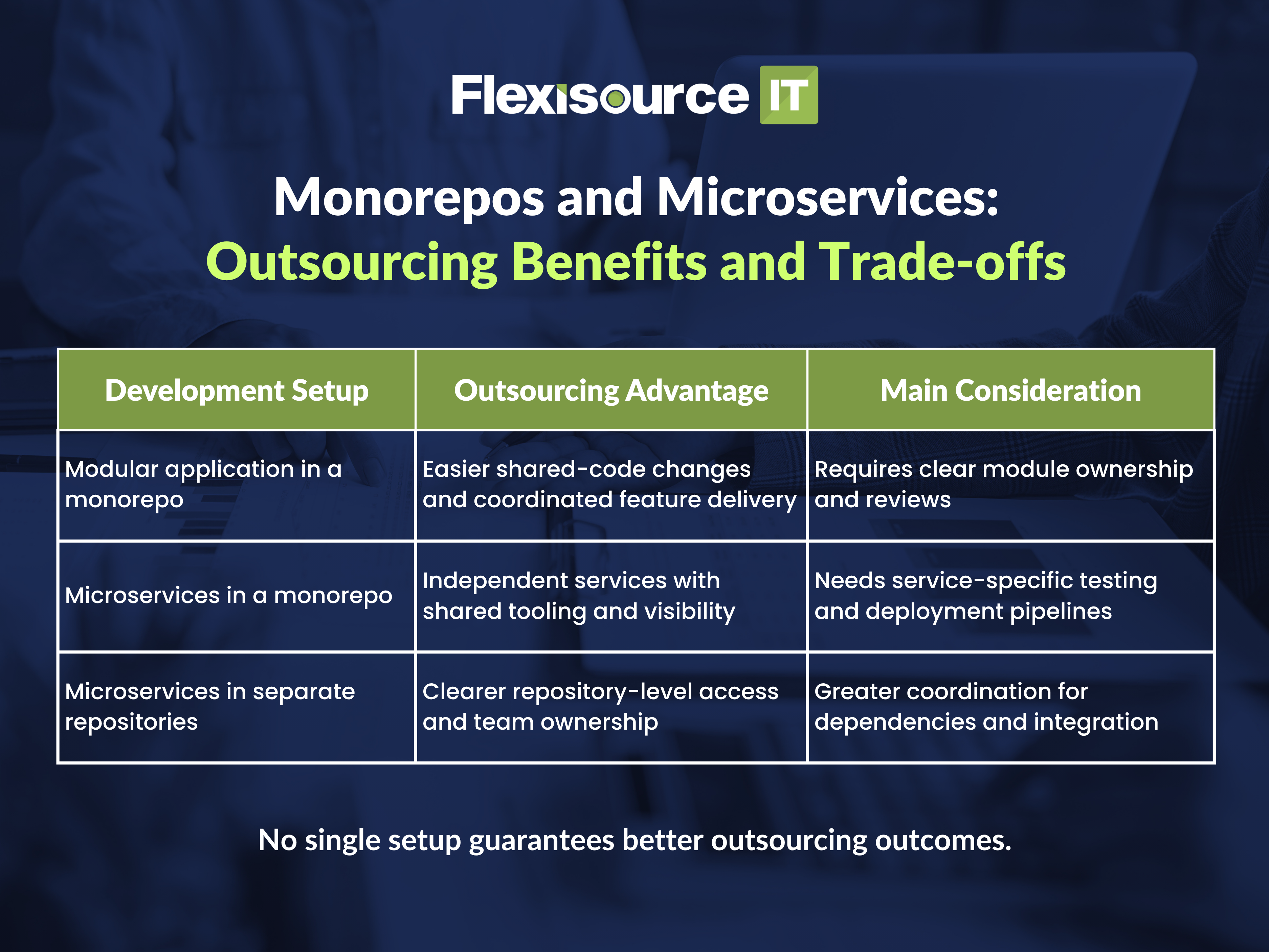
No arrangement guarantees better outsourcing outcomes. What matters is whether your development teams can work with clear responsibilities, appropriate permissions and predictable release processes.
When a Monorepo Works Well for Offshore Software Developers
A monorepo can be effective when internal and offshore developers regularly work across related applications or shared components.
Your Teams Frequently Change Shared Code
If developers frequently update the same libraries, interfaces or application components, a monorepo can make coordinated changes easier. This can benefit offshore teams working on full-stack features that span multiple projects.
You Want Consistent Engineering Standards
A shared repository can help teams use consistent development tools, testing standards and CI/CD practices. This is valuable when offshore developers must follow the same engineering requirements as your Australian team.
You Have Clear Code Ownership and Review Rules
A monorepo still needs defined responsibilities.
Tools such as GitHub’s CODEOWNERS can assign reviewers and require code-owner approval before changes are merged. However, these rules do not replace repository access controls. If offshore developers must not access unrelated source code, separate repositories or other suitable isolation measures may be necessary.
When Microservices Make More Sense for Outsourced Development
Microservices become more attractive when different teams need to manage distinct business capabilities, deploy independently and scale specific systems.
You Have Clearly Defined Business Capabilities
A service with a stable interface and clear responsibility can provide a suitable ownership boundary for an outsourced development team.
For example, offshore developers could maintain a notifications service while an internal team retains responsibility for payment processing.
Different Teams Need Independent Release Cycles
Microservices can help teams deliver changes without waiting for every other part of the application to be released. This can reduce coordination requirements, provided service dependencies and deployment pipelines support genuine independence.
You Can Support the Operational Complexity
Microservices require more than developers who can write individual services. Teams also need testing, observability, infrastructure management, incident response and API governance.
Martin Fowler’s guidance on microservices highlights the additional operational costs of managing distributed services. For smaller businesses, a well-structured modular application may be more practical than introducing microservices before they are necessary.
What to Check Before Outsourcing Software Development in Australia
Before engaging offshore software developers, review how your architecture supports external collaboration. These four areas should be agreed upon before development begins.
Who Owns Architecture and Technical Decisions?
Define who approves architectural changes, chooses technologies and manages shared dependencies. Your internal tech lead may retain overall architectural responsibility while offshore developers own implementation within clearly defined modules or services.
What Access Will Offshore Developers Need?
Review repository permissions, development environments, production access and sensitive credentials. Apply appropriate access controls without preventing developers from completing their responsibilities. Shared repositories require particular care when source-code visibility must be restricted.
Who Handles Testing, Integration and Deployment?
Agree on how changes move from development into production. Clarify responsibility for automated testing, integration failures, code reviews, deployment approvals and rollback procedures.
Microsoft’s CI/CD guidance recommends automated validation and reliable release pipelines to support independent service delivery.
How Will You Measure Delivery Quality?
Measure whether outsourcing actually improves delivery, rather than simply increasing developer capacity.
Useful indicators include:
- Pull request review time
- Development cycle time
- Deployment frequency
- Integration defects
- Rework and rollback rates
- Documentation and handover quality
These metrics can reveal whether architectural dependencies are making collaboration easier or creating unnecessary delays.
How Flexisource IT Supports Architecture-Aligned Development Teams
At Flexisource IT, we understand that successful software development outsourcing requires more than adding developers to a project.
Businesses need technical capability that fits their architecture, delivery processes and long-term goals.
Developers Matched to Your Technology Requirements
Our IT development services include custom software development and quality assurance, helping businesses access technical resources suited to their project requirements.
Offshore Teams That Work With Your Existing Processes
Whether your organisation uses a monorepo, microservices or a modular application, effective collaboration depends on clear expectations, technical documentation and consistent review practices. Flexisource IT supports Agile-led delivery and collaboration with client teams.
Flexible Development Capacity as Your Product Grows
As your application evolves, development requirements may change. Adding offshore development and QA capacity around well-defined responsibilities can help businesses scale their teams without unnecessarily restructuring their existing architecture.
Final Thoughts: Choose the Architecture That Supports Your Team
The decision is not simply monorepo versus microservices. It is about choosing a technical structure that supports clear ownership, efficient collaboration and manageable operational complexity.
A monorepo can improve shared development, while microservices can support independent delivery. Both can work together when responsibilities and engineering processes are clearly defined.
For Australian businesses considering custom software development outsourcing, architecture should support the people building the product, not create unnecessary obstacles for them.
Looking to outsource software development in Australia? Contact Flexisource IT to discuss building an offshore development team that works with your existing systems, technical standards and business objectives.
Read next: