When you’re buying, often the question that pops in your mind is, “Can this vendor provide AI-capable talent?”
But, if you’re a serious buyer, you need to ask, “How does this vendor source, assess and support that talent responsibly?”
At Flexisource IT, we help businesses build offshore teams with clear hiring standards, practical governance and a strong focus on long-term delivery quality.
Why Ethical AI Hiring Matters in IT Outsourcing
AI is changing how outsourcing vendors find, screen and assess technical talent. Used well, it can help recruiters organise candidate information, match skills to roles and improve hiring speed. Used poorly, it can introduce bias, weaken transparency or create privacy issues that clients only discover after the fact.
For enterprise-leaning buyers, this makes ethical AI hiring part of vendor due diligence. A provider’s recruitment process is no longer just an internal HR matter. It is part of the risk profile of the outsourcing relationship.
Australia’s AI Ethics Principles highlight values such as fairness, privacy protection, security, transparency and accountability. These are directly relevant to recruitment because hiring decisions affect people’s opportunities, careers and personal data.
AI Is Changing How Vendors Source and Screen Talent
AI can now support many parts of recruitment, including candidate sourcing, CV screening, skills matching, interview preparation and technical assessment review.
That does not make AI bad. In a competitive talent market, AI can help vendors work faster and manage larger candidate pools. The issue is whether the process remains fair, explainable and properly reviewed by humans.
For example, if AI is used to shortlist developers, QA engineers, DevOps specialists or support staff, buyers should understand how those recommendations are reviewed. The vendor should be able to explain what criteria are used, whether candidates are assessed consistently and who makes the final decision.
In AI in IT outsourcing, speed should never be the only goal. The better outcome is a hiring process that is faster, more consistent and still responsible.
Buyers Are Now Vetting Governance, Not Just Skills
A vendor may have access to strong technical talent, but that is not enough if the hiring process lacks governance. Procurement, legal and technology leaders increasingly need to know whether AI is being used responsibly in recruitment and workforce management.
The UK Government’s Responsible AI in Recruitment guide frames AI recruitment as a procurement and assurance issue, not just an HR efficiency tool. It highlights the need to consider risks around fairness, transparency, explainability, contestability, security and human oversight when AI is used in hiring.
For buyers, this means vendor questions should go beyond rates, availability and technical skills. They should also include:
- How is AI used in recruitment?
- Are hiring decisions reviewed by humans?
- How is candidate data protected?
- How are bias and unfair screening risks managed?
- How are technical skills validated beyond AI-generated summaries?
These questions help buyers identify vendors that can support AI-enabled delivery without creating unnecessary risk.
Ethical AI Hiring Is More Than Using AI Tools
Ethical AI hiring is not just about whether a vendor uses AI recruitment software. It is about how the vendor uses AI, where human judgement remains involved and how decisions are explained, reviewed and documented.
This distinction matters because many buyers are not only looking for faster hiring. They want confidence that the people joining their offshore teams have been assessed fairly, selected for real capability and supported with clear standards once they begin work.
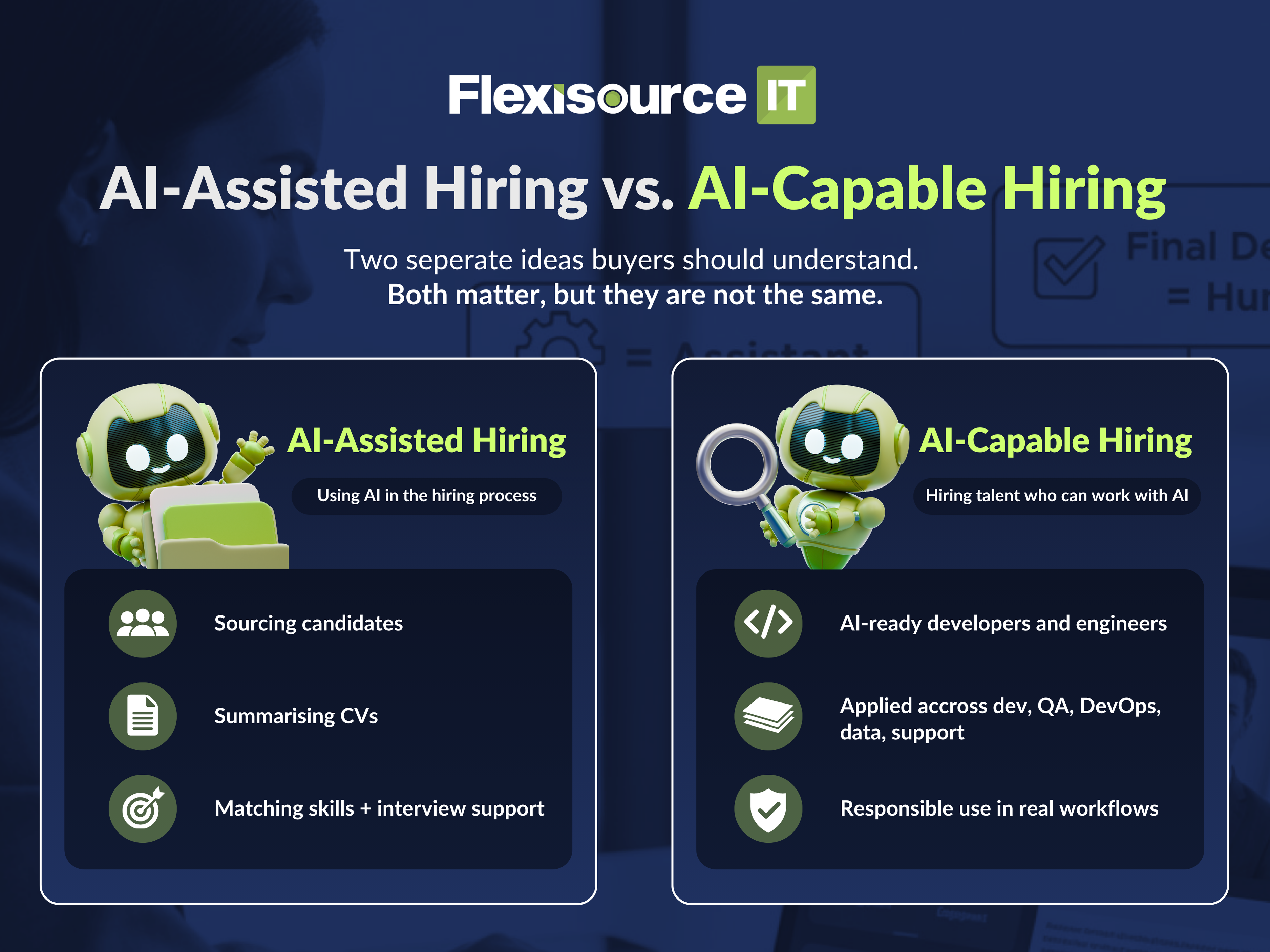
AI-Assisted Hiring vs. AI-Capable Hiring
There are two separate ideas buyers should understand.
AI-assisted hiring means using AI tools to support the recruitment process. This may include sourcing candidates, summarising CVs, matching skills to job descriptions or helping structure interview questions.
AI-capable hiring means hiring IT professionals who can work effectively with AI tools in software development, QA, DevOps, data, support or automation workflows.
Both matter, but they are not the same.
A vendor might use AI to screen candidates but still fail to assess whether those candidates can apply AI responsibly in real engineering environments. On the other hand, a vendor might hire strong AI-capable developers but lack clear policies for using AI in recruitment.
Strong vendors need both: responsible hiring processes and practical assessment of AI-ready technical skills.
Human Judgement Still Needs to Lead the Process
AI should support hiring decisions, not replace human judgement. This is especially important in technical outsourcing, where CVs and keyword matches rarely tell the full story.
A developer may mention AI tools on their CV, but that does not prove they understand secure coding, maintainability, code review, system design or client communication. Likewise, an AI screening tool may rank candidates based on visible keywords while missing practical experience or transferable skills.
Human review helps balance these limitations. Recruiters, technical interviewers and hiring managers should assess the candidate’s real ability, not simply accept an automated recommendation.
Australian public sector recruitment guidance also continues to emphasise human selection decisions, fairness, transparency and privacy when AI is involved in recruitment processes.
Read: Ethical Use of AI in Hiring: How Businesses Can Recruit Faster Without Losing the Human Touch
4 AI Hiring Risks Buyers Should Evaluate
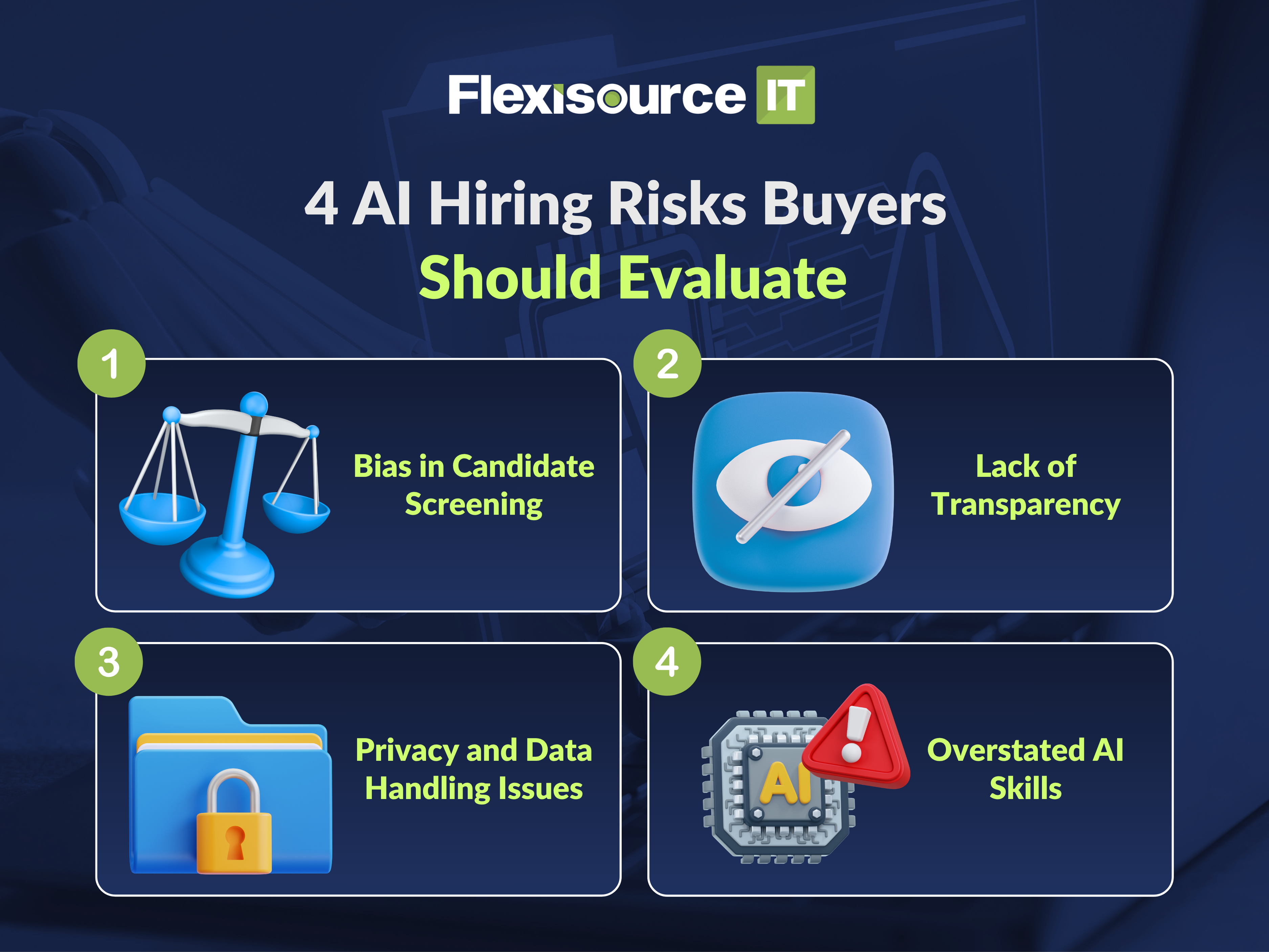
Ethical AI hiring is important because AI can create risks that are not always obvious during vendor selection. Buyers do not need to reject vendors that use AI. They need to understand whether AI is being used with proper controls.
Bias in Candidate Screening
AI tools can reflect patterns from the data they are trained on or the criteria they are given. If past hiring data or job descriptions contain bias, AI-assisted screening may repeat those patterns.
That is why candidate evaluation should be based on role-relevant skills, consistent standards and human review. Buyers should ask whether the vendor checks for unfair screening outcomes and whether candidates are assessed against clear technical criteria.
Lack of Transparency
Transparency matters for both candidates and clients. Candidates should understand when AI is involved in the hiring process, especially if it affects screening, assessment or communication.
Clients should also have visibility into how offshore team members are selected. They do not need every internal recruitment detail, but they should know that AI-assisted processes are governed, reviewed and aligned with fair hiring principles.
Privacy and Data Handling Issues
Recruitment involves personal information, technical assessments, work history and sometimes sensitive candidate data. If AI tools are used, vendors need clear rules around what data is entered, how it is stored and who can access it.
For buyers evaluating Philippine IT talent AI capability, this is especially important. Responsible vendors should protect candidate data while also giving clients confidence that offshore team members are selected through secure and well-governed hiring processes.
Overstated AI Skills
Another risk is assuming that AI familiarity equals strong technical capability. A candidate may know how to use AI coding tools, but that does not automatically mean they understand secure development, maintainability, testing, documentation or business context.
For buyers, this matters because AI-capable talent should still be evaluated on real engineering ability. Vendors should validate whether candidates can use AI responsibly as part of quality software delivery, not just whether they can generate code quickly.
What Ethical AI Hiring Looks Like in Practice
Ethical AI hiring should be practical, not just policy-driven. Buyers should look for vendors that can explain how AI is used, how people are assessed and how final hiring decisions are made.
| Area to Review | What Buyers Should Ask | What a Strong Vendor Should Show |
| AI use in recruitment | Do you use AI in sourcing, screening or assessments? | A clear explanation of where AI is used and where human review is required. |
| Candidate screening | How do you decide which candidates move forward? | Skills-based criteria, consistent evaluation standards and human oversight. |
| Bias control | How do you check for unfair screening outcomes? | Regular review of screening criteria, interview consistency and role-relevant assessments. |
| Candidate transparency | Are candidates told when AI is part of the process? | Clear communication when AI supports screening, assessment or candidate matching. |
| Privacy and data handling | What candidate data is collected, stored or entered into AI tools? | Limited data collection, secure storage and clear rules on what information can be used. |
| Technical validation | How do you verify AI and technical skills? | Human-reviewed technical assessments, practical interviews and role-specific evaluation. |
| Human accountability | Who makes the final hiring decision? | Named recruiters, technical leads or hiring managers responsible for the decision. |
| AI-capable talent | How do you assess whether candidates can use AI responsibly? | Evidence that candidates understand quality, security, documentation and review standards. |
| Ongoing governance | What AI policies apply once the person joins a client team? | Clear rules for AI tool use, client data protection, code quality and escalation. |
This gives procurement, legal and technology leaders a more useful way to assess vendors. The issue is not whether a provider uses AI. The issue is whether AI is used with proper oversight.
Questions to Ask an IT Outsourcing Vendor Before Signing
Before choosing a vendor, buyers should ask direct questions about ethical AI hiring and AI talent governance.
Useful questions include:
- Do you use AI in sourcing, screening or assessments?
- Are candidates told when AI is used?
- What candidate data is collected and where is it stored?
- Who makes the final hiring decision?
- How do you check for bias or unfair screening patterns?
- Are technical assessments reviewed by humans?
- How do you validate AI skills beyond tool familiarity?
- What AI usage policies apply once the person joins a client team?
- How do you train offshore staff to use AI responsibly?
A strong vendor should be able to answer these clearly. If the answers are vague, that may be a sign that the provider is using AI faster than it is governing it.
Why Philippine IT Talent Is Well Positioned for Responsible AI Work
The Philippines has a strong outsourcing and IT talent base, making it a natural market for companies looking to build AI-capable offshore teams. But the goal should not be to hire people who simply use AI tools. The goal should be to hire professionals who can use AI with sound technical judgement.
For buyers evaluating Philippine IT talent AI capability, responsible hiring means looking for a mix of technical skill, communication ability, documentation habits and quality discipline.
Related: Philippines vs India for Offshore Development: Which Is Better?, The AUD Advantage: A Smarter Time to Offshore
AI Skills Should Be Paired With Engineering Discipline
AI can help developers, QA testers, support teams and automation specialists work more efficiently. However, AI output still needs human review. Strong offshore talent should understand when to use AI, when to question it and how to document decisions clearly for the client’s internal team.
Responsible Vendors Invest in Training and Governance
Responsible AI hiring does not end once a candidate is selected. Vendors should also support ongoing training, clear AI usage policies and client-aligned delivery standards. This helps ensure offshore team members use AI in a way that supports quality, security and accountability.
How Flexisource IT Approaches Ethical AI Hiring
At Flexisource IT, we understand that ethical AI hiring is becoming part of serious outsourcing due diligence. Businesses want capable people, but they also want confidence in how those people are sourced, assessed and supported.
Skills-Based Talent Selection
We focus on practical technical capability, communication skills and role fit. AI may support parts of the hiring process, but candidates still need to show real ability.
Human-Led Screening and Evaluation
Human judgement remains central to candidate assessment. Technical skills, problem-solving ability and client fit should not be decided by automation alone.
Responsible AI Use Across Offshore Teams
We support responsible AI use through clear expectations, quality standards and client alignment. This helps offshore teams use AI as a productivity tool without weakening accountability.
Final Thoughts: Ethical AI Hiring Will Become a Vendor Differentiator
Ethical AI hiring is becoming an important part of IT outsourcing due diligence. Buyers should not only ask whether a vendor can provide AI-capable talent. They should ask how that talent is sourced, assessed, trained and supported responsibly.
For companies evaluating AI in IT outsourcing, the right partner should combine technical capability with fairness, privacy, human oversight and clear governance.
Looking for an IT outsourcing partner that understands both AI capability and responsible hiring? Contact Flexisource IT to build an offshore team supported by clear recruitment, governance and delivery standards.