As organisations receive more applications and compete for skilled talent, AI is becoming a valuable recruitment tool. However, successful hiring still depends on people who can recognise potential, build relationships, and make informed decisions that technology alone cannot.
At Flexisource IT, we help Australian businesses embrace digital transformation with skilled technology professionals who understand that the best recruitment strategies combine smart technology with people-first thinking. In this guide, you’ll learn how to use AI responsibly, where it adds the most value, and why human judgement remains essential to building strong teams.
What Is the Ethical Use of AI in Hiring?
The ethical use of AI in hiring means using artificial intelligence responsibly to support recruitment while ensuring decisions remain fair, transparent, unbiased, and centred on people.
AI can automate repetitive tasks such as screening applications, scheduling interviews, and analysing recruitment data, but human recruiters should always oversee important hiring decisions. The goal is to improve efficiency without compromising fairness, accountability, or the candidate experience.
Why Businesses Are Using AI in Recruitment
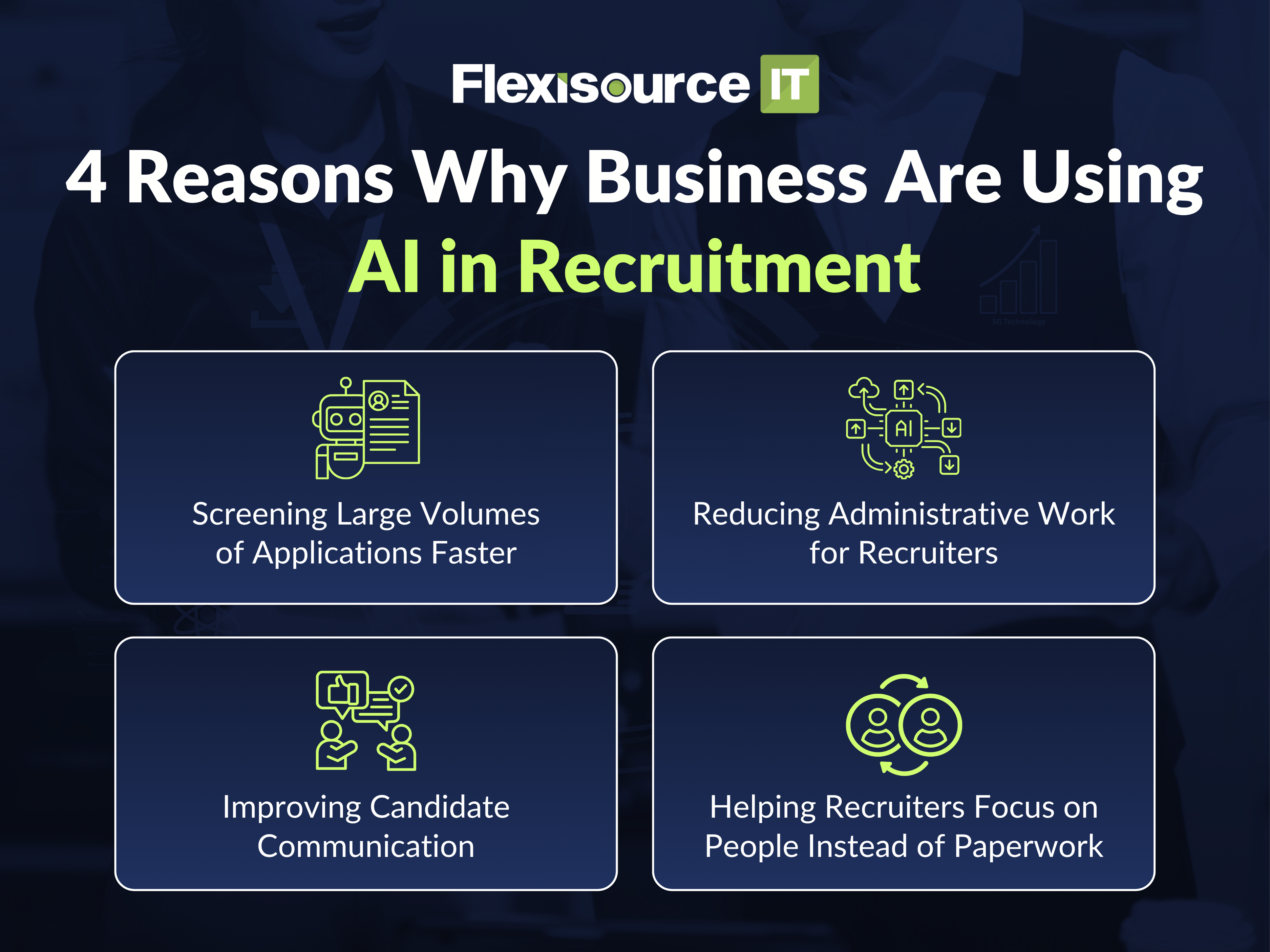
Hiring has become more competitive as businesses receive larger numbers of applications and compete for skilled talent. AI helps recruiters manage these growing workloads by automating repetitive tasks, allowing hiring teams to spend more time engaging with candidates and making informed hiring decisions.
Screening Large Volumes of Applications Faster
Reviewing hundreds of applications manually takes significant time and effort. AI-powered recruitment tools can quickly scan CVs, identify relevant skills, and organise candidates based on predefined criteria. This allows recruiters to focus their attention on the strongest applicants sooner, helping businesses reduce hiring delays without compromising quality.
Reducing Administrative Work for Recruiters
Recruitment involves far more than interviewing candidates. Hiring teams also spend time scheduling interviews, organising documents, updating applicant tracking systems, and communicating with applicants throughout the recruitment process.
Read: AI in Interviews: How Candidates and Employers Are Adapting to Smarter Hiring
Improving Candidate Communication
Candidates appreciate timely updates throughout the hiring process. AI-powered chatbots, automated email workflows, and interview scheduling tools help businesses acknowledge applications, answer common questions, and keep candidates informed at every stage.
Helping Recruiters Focus on People Instead of Paperwork
One of AI’s greatest strengths is reducing repetitive work that adds little strategic value. When technology handles administrative tasks, recruiters have more time to evaluate candidates, understand career goals, assess cultural fit, and build meaningful relationships.
Where AI Adds Value Throughout the Hiring Process
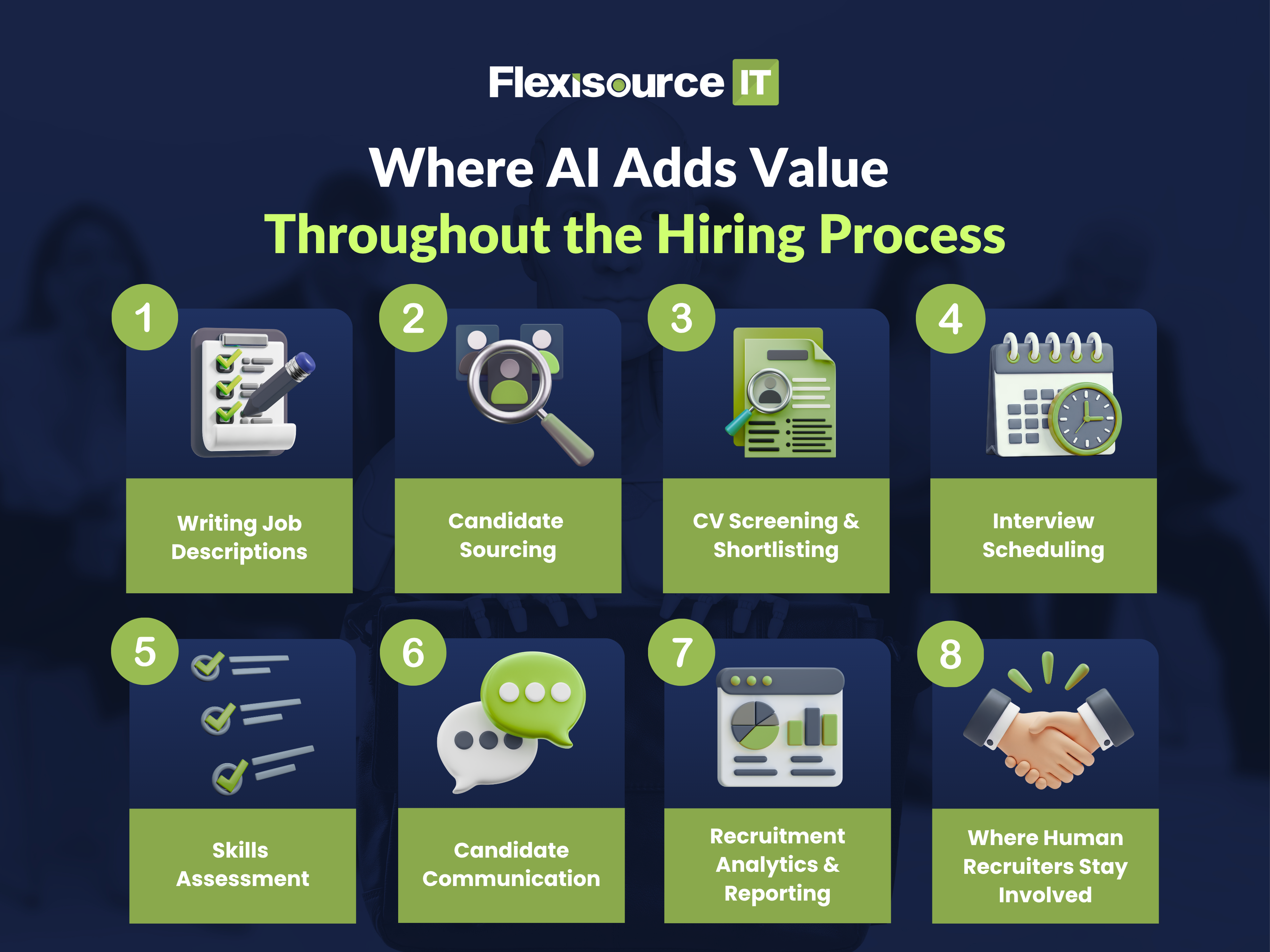
AI can support almost every stage of recruitment, but it delivers the best results when it handles repetitive tasks while recruiters remain responsible for decisions that require judgement, empathy, and business understanding.
Some of the most valuable ways businesses can use AI without compromising the ethical use of AI in hiring are:
1. Writing Job Descriptions: AI helps draft clear, inclusive, and engaging job descriptions faster. Recruiters should review every description to ensure it reflects the role, company culture, and hiring goals.
2. Candidate Sourcing: AI searches talent databases and professional networks to identify suitable candidates, allowing recruiters to spend less time searching and more time engaging with qualified talent.
3. CV Screening and Shortlisting: AI quickly reviews applications and creates an initial shortlist based on predefined criteria. Human recruiters should always review shortlisted candidates to support the ethical use of AI in hiring.
4. Interview Scheduling: AI automates calendar coordination, sends invitations, and manages rescheduling, creating a smoother experience for both recruiters and candidates.
5. Skills Assessments: AI can administer and analyse assessments more efficiently, but results should always be considered alongside interviews, experience, and professional judgement.
6. Candidate Communication: AI keeps candidates informed through automated updates, reminders, and answers to common questions, while recruiters handle personalised conversations and feedback.
7. Recruitment Analytics and Reporting: AI analyses hiring data, identifies recruitment trends, and measures key metrics, helping businesses make better hiring decisions over time.
8. Where Human Recruiters Should Always Stay Involved: Human recruiters should lead interviews, assess communication and cultural fit, manage complex situations, and make final hiring decisions. AI supports the process, but people remain responsible for the outcome.
The most successful organisations combine AI with experienced recruiters who understand both the technical requirements of the role and the human qualities that contribute to long-term success.
Where Does Human Judgement Still Matter at This Point?
AI can process information in seconds, but recruitment is about much more than matching keywords on a CV. Every hiring decision affects people, teams, and the future of a business. While AI improves efficiency, human recruiters continue to play the most important role in evaluating potential, building relationships, and making fair decisions.
Understanding Candidate Potential Beyond the CV/Resume
A CV tells only part of a candidate’s story. It highlights previous experience and qualifications, but it cannot fully capture ambition, adaptability, resilience, or the ability to learn new skills.
Experienced recruiters look beyond job titles and technical skills to understand how a candidate might grow within the organisation. They recognise transferable skills, leadership potential, and qualities that AI may struggle to identify through data alone.
Evaluating Communication and Cultural Fit
Hiring someone with the right technical skills is only part of building a successful team. Candidates also need to communicate effectively, collaborate with colleagues, and align with the organisation’s values and ways of working.
These qualities are best assessed through meaningful conversations and human interaction. AI can support the recruitment process, but it cannot fully understand workplace relationships, team dynamics, or organisational culture.
Managing Bias Through Human Oversight
One of the biggest reasons for the ethical use of AI in hiring is ensuring recruitment remains fair. AI systems learn from existing data, and if that data contains bias, the AI may unintentionally produce biased outcomes.
Human oversight helps identify these issues before they affect hiring decisions. Recruiters can review recommendations, question unexpected results, and ensure every candidate is assessed fairly using consistent criteria.
Making Fair Hiring Decisions
Recruitment often involves balancing multiple factors rather than choosing the candidate with the highest score. Hiring managers may consider experience, technical ability, communication skills, growth potential, team needs, and long-term business goals.
These decisions require professional judgement, critical thinking, and business understanding that AI cannot fully replicate. Human recruiters remain responsible for making balanced decisions that consider both the organisation and the candidate.
Building Trust With Candidates
Every interaction shapes how candidates view your organisation. Even applicants who are not selected should leave with a positive impression of the recruitment process.
Recruiters build trust by listening, answering questions, providing personalised feedback, and communicating openly throughout the hiring journey. These human interactions strengthen employer branding and encourage talented candidates to apply again in the future.
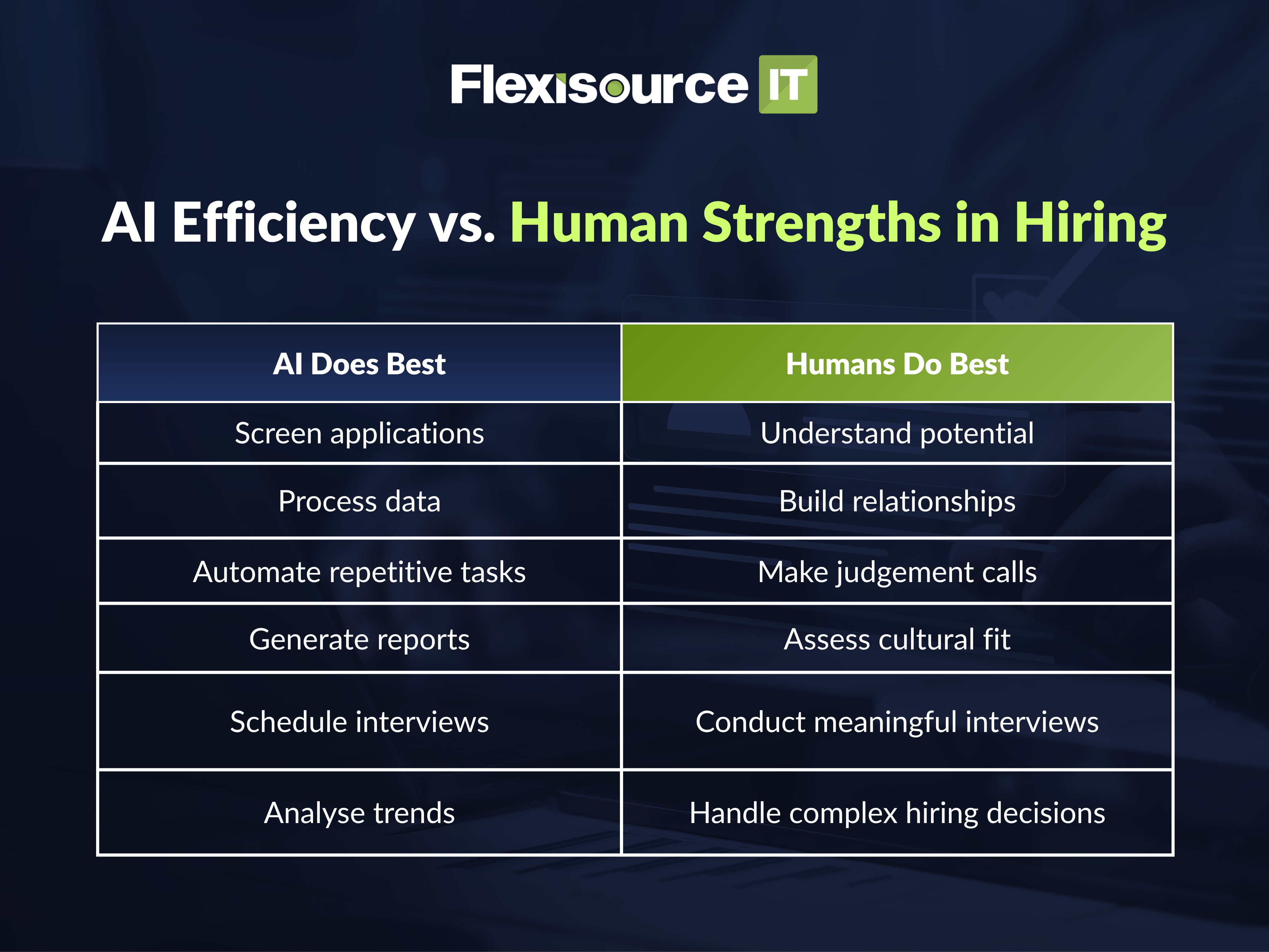
Rather than viewing AI and recruiters as competitors, businesses should understand how each contributes to better hiring outcomes. The strongest recruitment strategies combine AI’s efficiency with human judgement and relationship-building.AI vs. Human Strengths
Related: Why Human Talent Still Matters in AI-Driven Outsourcing
The Biggest Ethical Risks of AI in Hiring
AI can improve recruitment, but it also introduces new responsibilities. Businesses that rely too heavily on automation without proper oversight may unintentionally create unfair hiring practices or damage candidate trust. The ethical use of AI in hiring means recognising these risks early and putting the right safeguards in place.
Algorithmic Bias
AI systems learn from the data they are trained on. If historical hiring data contains bias, the AI may unintentionally favour certain candidates while overlooking others with equal or greater potential.
Businesses should regularly review AI recommendations, test recruitment tools for fairness, and ensure hiring decisions are based on consistent, objective criteria. Human oversight remains one of the most effective ways to reduce bias and support fair recruitment.
Lack of Transparency
Candidates increasingly want to know how AI is being used during recruitment. If businesses rely on automated tools without explaining their purpose, applicants may lose confidence in the hiring process.
Being transparent about where AI is used, how candidate information is assessed, and when human recruiters are involved helps build trust while supporting the ethical use of AI in hiring.
Data Privacy Concerns
Recruitment involves collecting personal information, including CVs, contact details, employment history, qualifications, and assessment results. Businesses must ensure this data is collected, stored, and processed securely.
AI recruitment platforms should comply with relevant privacy regulations and use appropriate security measures to protect candidate information. Responsible data handling is a key part of ethical recruitment.
Read: Cloud Support Services: Why Businesses Are Outsourcing Cloud Management
Over-Reliance on Automation
AI is designed to support recruiters, not replace them. Businesses that depend entirely on automated recommendations risk overlooking strong candidates whose experience or potential may not fit predefined patterns.
Recruiters should treat AI as a decision-support tool rather than the final decision-maker. Reviewing recommendations, conducting interviews, and considering the wider business context lead to more balanced hiring outcomes.
Removing Human Accountability
Technology cannot take responsibility for hiring decisions. If an AI system makes an unsuitable recommendation or unintentionally introduces bias, accountability still rests with the organisation using the technology.
Every recruitment process should include clear human ownership. Recruiters and hiring managers should review AI-generated insights, validate important decisions, and remain accountable for every hiring outcome.
Common Myths About AI in Hiring
As AI becomes more common in recruitment, there are many misconceptions that continue to shape how businesses view the technology. Understanding what AI can and cannot do helps organisations make better decisions and adopt more responsible hiring practices.
| Myth | Reality |
| AI will replace recruiters. | AI supports recruiters by automating repetitive tasks, but people still make the most important hiring decisions. |
| AI is completely unbiased. | AI can inherit bias from historical data, which is why regular human review is essential. |
| AI always chooses the best candidate. | AI identifies patterns, but recruiters evaluate communication, potential, and cultural fit. |
| AI makes recruitment less personal. | When used well, AI removes administrative work so recruiters can spend more time engaging with candidates. |
| Ethical AI slows recruitment | Responsible AI improves efficiency while maintaining fairness, transparency, and accountability. |
How Flexisource IT Helps Businesses Build Smarter Recruitment Processes
Businesses adopting AI need more than new technology. They need the right people, systems, and technical expertise to implement AI responsibly and support long-term growth. At Flexisource IT, we help Australian businesses build technology teams that combine innovation with human expertise, allowing organisations to embrace AI while maintaining quality, accountability, and strong collaboration.
Building AI-Ready Development and Technology Teams
AI solutions require experienced developers, engineers, data specialists, and technology professionals who understand how to build, integrate, and maintain modern systems. Flexisource IT helps businesses access skilled offshore talent that can support AI projects while ensuring solutions remain secure, scalable, and aligned with business goals.
Our dedicated teams work alongside Australian organisations, providing the technical capability needed to accelerate digital transformation without compromising quality.
Supporting Ethical Digital Transformation
Successful AI adoption involves more than implementing new tools. Businesses also need governance, responsible AI practices, security controls, and clear processes that support ethical decision-making.
Flexisource IT works with organisations to build technology teams that understand both innovation and responsibility, helping businesses introduce AI in ways that improve efficiency while maintaining trust and accountability.
Combining Technology With Human Expertise
The strongest AI solutions are built by talented people using smart technology. Our offshore professionals use AI to improve productivity, automate repetitive work, and support faster delivery, but every project continues to benefit from human judgement, collaboration, and quality assurance.
This balanced approach helps businesses achieve the speed of automation without losing the creativity, communication, and critical thinking that experienced professionals bring to every project.
Helping Australian Businesses Scale Responsibly
As businesses grow, so do their technology needs. Flexisource IT helps Australian organisations build dedicated offshore teams that can scale alongside changing priorities while maintaining strong communication, reliable delivery, and consistent technical standards.
Whether you’re developing AI-powered applications, modernising existing systems, or expanding your technology team, we help you combine skilled professionals with modern AI capabilities to support sustainable business growth.
Ethical AI Hiring Must Always Start With People
Sure, AI is transforming recruitment by helping businesses hire faster, improve efficiency, and reduce repetitive administrative work. However, technology alone cannot build diverse teams, recognise potential, or create positive candidate experiences. Those outcomes still depend on people.
The ethical use of AI in hiring is about finding the right balance between automation and human judgement. AI can streamline recruitment and provide valuable insights, but recruiters remain responsible for fairness, transparency, communication, and accountability throughout the hiring process.
Businesses that embrace this balanced approach will be better positioned to attract top talent, strengthen employer reputation, and make more confident hiring decisions. Rather than replacing recruiters, AI empowers them to focus on what matters most: building relationships, understanding people, and making thoughtful decisions that support long-term business success.
If your business is looking to embrace AI while building skilled technology teams that put people first, Flexisource IT can help. We support Australian organisations with dedicated offshore professionals who combine technical expertise, responsible innovation, and strong collaboration to help businesses grow with confidence.
Read next:
- How to Hire AI Developers
- Philippines vs India for Offshore Development: Which Is Better?
- What Is Agentic AI? How Autonomous AI Agents Are Changing Business Automation
- AI Development Company in Australia: AI and Software Development for Growth
- The AUD Advantage: A Smarter Time to Offshore
- AI Development Services: How Founders and Product Teams Build Real, Scalable AI Solutions