AI is already replacing certain offshore IT tasks, particularly repetitive work such as ticket classification, basic data processing, routine reporting and standardised code generation. However, it is also changing what offshore professionals do rather than eliminating the need for them entirely. Developers spend more time reviewing AI-generated code, support specialists handle complex issues, and QA engineers focus on testing strategy and exceptions.
The future of IT outsourcing will depend on which tasks businesses can automate reliably, which responsibilities still require human judgement and how both can work together.
At Flexisource IT, we help Australian businesses build offshore teams that can adapt to changing technology, technical requirements and business priorities.
Is AI Replacing Offshore Jobs or Changing How They Work?
AI is doing both, but not equally across every role. Some tasks can now be automated with minimal human involvement, while others become more valuable precisely because AI handles the repetitive parts.
For businesses evaluating AI in IT outsourcing, the important distinction is between replacing a task and replacing an entire job.
Task Automation Is Not the Same as Job Replacement
Most IT roles involve several responsibilities. A support specialist might classify tickets, troubleshoot issues, communicate with users, document solutions and escalate incidents. AI may automate ticket classification without being able to handle every other responsibility reliably. The employee’s workload changes, but the entire role does not necessarily disappear.
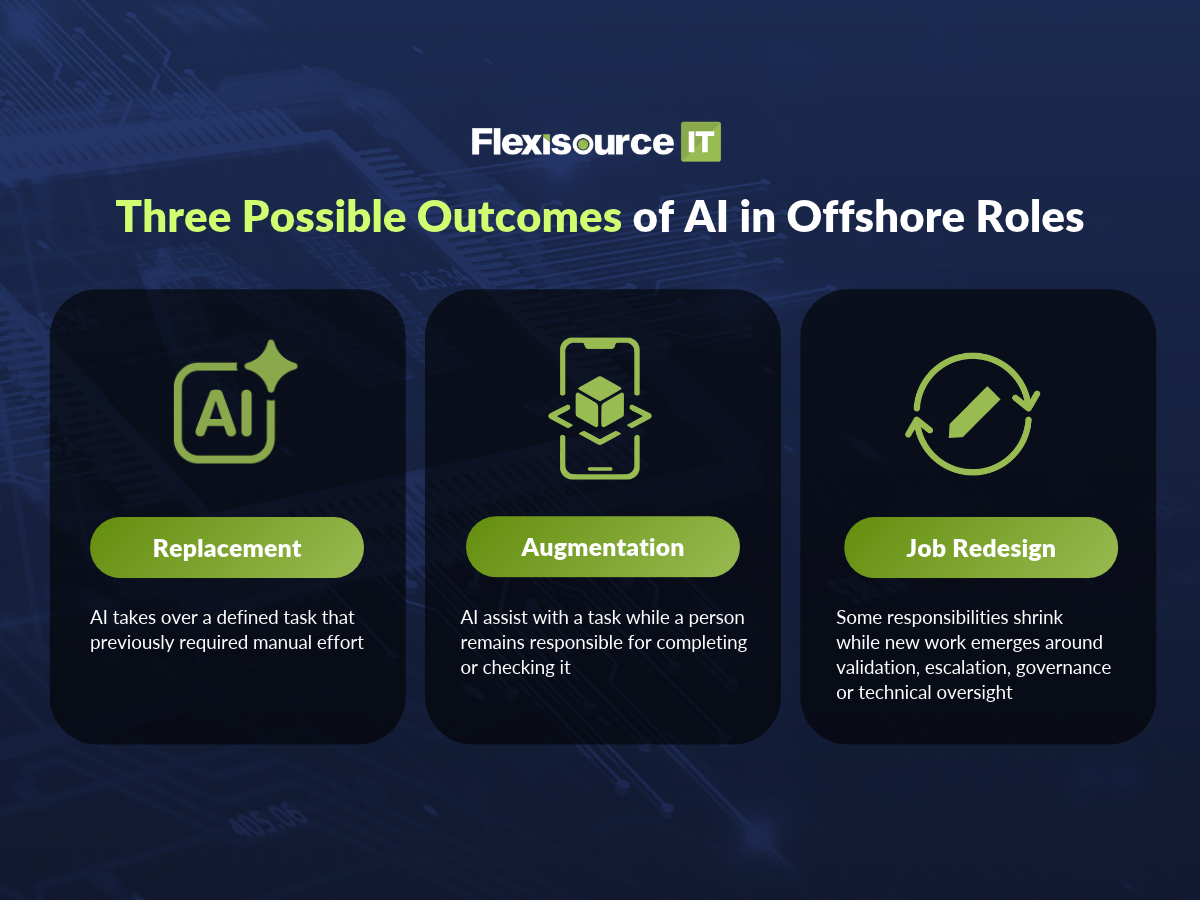
There are three possible outcomes:
- Replacement: AI takes over a defined task that previously required manual effort.
- Augmentation: AI assists with a task while a person remains responsible for completing or checking it.
- Job redesign: Some responsibilities shrink while new work emerges around validation, escalation, governance or technical oversight.
However, job displacement is still possible. If automation removes enough work from a position, a business may reduce staffing requirements or combine responsibilities.
AI Is Changing the Economics of Outsourcing
Traditional outsourcing often focuses on accessing skilled talent at a lower operating cost. AI adds another consideration: whether certain tasks still need to be performed manually.
For example, a company paying for repetitive data processing may find that automation can complete much of that work. Instead of maintaining the same manual workflow, the business may need fewer processing hours and more technical expertise to validate results, manage exceptions and maintain the system.
That changes what companies should expect from outsourcing partners.
The question becomes less about how many people can complete the work and more about which combination of automation and expertise delivers the best results.
What Recent Research Says About IT Outsourcing
The International Labour Organization’s 2025 global assessment found that approximately one in four workers worldwide is in an occupation with some generative AI exposure. However, the research suggests job transformation is more likely than complete replacement for most occupations.
The Philippines faces significant exposure. A February 2026 ILO research brief estimates that 12.7 million Philippine jobs have some exposure to generative AI. Crucially, exposure does not mean those jobs will disappear.
Anthropic’s June 2026 Economic Index also distinguishes between tasks delegated to AI and tasks performed collaboratively with people. This reinforces why AI usage should not be confused with confirmed job displacement.
For offshore IT providers, these findings point towards a changing mix of work rather than one outcome across the entire industry.
Where AI Can Genuinely Replace Offshore Tasks
AI is most suitable for work that follows repeatable patterns, has clear rules and can be checked against defined outcomes. However, successful automation also depends on system integration, data quality, security permissions and the consequences of errors.
Routine IT Support and Ticket Handling
Some Level 1 IT support activities are strong automation candidates, including:
- Categorising and routing incoming tickets
- Answering common knowledge-base questions
- Guiding users through standard troubleshooting steps
- Initiating approved password-reset workflows
- Generating ticket summaries
For example, an AI-supported helpdesk may automatically classify a request, retrieve the correct troubleshooting instructions and complete an approved workflow without a technician manually handling every step.
However, identity verification, unexpected errors and sensitive access requests still need appropriate safeguards.
As our article on measuring offshore helpdesk performance explains, resolving issues properly matters more than simply processing more tickets.
Repetitive Software Development and Testing
AI can automate parts of software development, particularly tasks involving predictable patterns. Examples include boilerplate code generation, routine scripting, test-case drafting and repetitive code explanations.
However, faster code generation can also make offshore code reviews more challenging, as developers must spend more time validating AI-generated changes. Human reviewers still need to ensure that the code meets business requirements, integrates with existing systems and does not introduce security or maintainability problems.
Standardised Data Processing and Reporting
AI can also reduce manual work involving document classification, information extraction, data formatting and routine report preparation.
For example, a system may extract structured information from standardised forms and transfer it into an approved business workflow. Unusual inputs, inaccurate extraction and inconsistent records still require validation.
The strongest automation opportunities are tasks where outputs can be checked reliably, not simply tasks that appear repetitive.
Where AI Changes Offshore Roles Instead of Replacing Them
Some responsibilities become more important as AI handles routine work.
In these areas, offshore professionals may spend less time producing first drafts or completing repetitive steps and more time applying judgement, investigating problems and ensuring quality.
Software Developers Become More Responsible for Validation
AI coding assistants can produce code quickly, but developers remain responsible for determining whether that code belongs in the application. This shifts more attention towards architecture, integration, security, testing and maintainability.
The productivity benefit is not guaranteed. In a 2025 METR study, experienced open-source developers took 19% longer to complete tasks when allowed to use AI tools in the particular environment studied. The researchers cautioned against applying that result to all development work.
2025 Study Found Developers Took 19% Longer With AI Tools
For offshore development teams, the lesson is to measure completed, verified work rather than assuming AI-generated output automatically improves productivity.
IT Support Specialists Handle More Complex Problems
When AI resolves common requests, the issues reaching human support specialists may become more complicated. These can include recurring incidents, unusual system behaviour, failed automated workflows and situations requiring communication across multiple teams.
Instead of repeatedly handling straightforward requests, support professionals may increasingly investigate exceptions and resolve problems that automation cannot. This makes troubleshooting ability, communication and technical judgement important parts of Level 1-3 IT support services.
QA Engineers Focus More on Risk and Test Strategy
AI can assist with generating test cases, identifying potential defects and preparing testing documentation. However, quality assurance involves deciding what needs testing, understanding user behaviour and identifying risks that automated checks may miss.
QA professionals may spend more time on exploratory testing, edge cases, usability and complex defect investigation.
For businesses investing in offshore QA testing, AI can support testing capacity without removing the need for experienced testers.
Technical Leaders Take Greater Responsibility for AI Oversight
As automated workflows become more common, technical leaders must decide where AI can operate independently and where approval is required. This includes setting access permissions, defining escalation rules, monitoring errors and assigning accountability when something goes wrong.
AI may reduce manual execution, but it also introduces new management responsibilities.
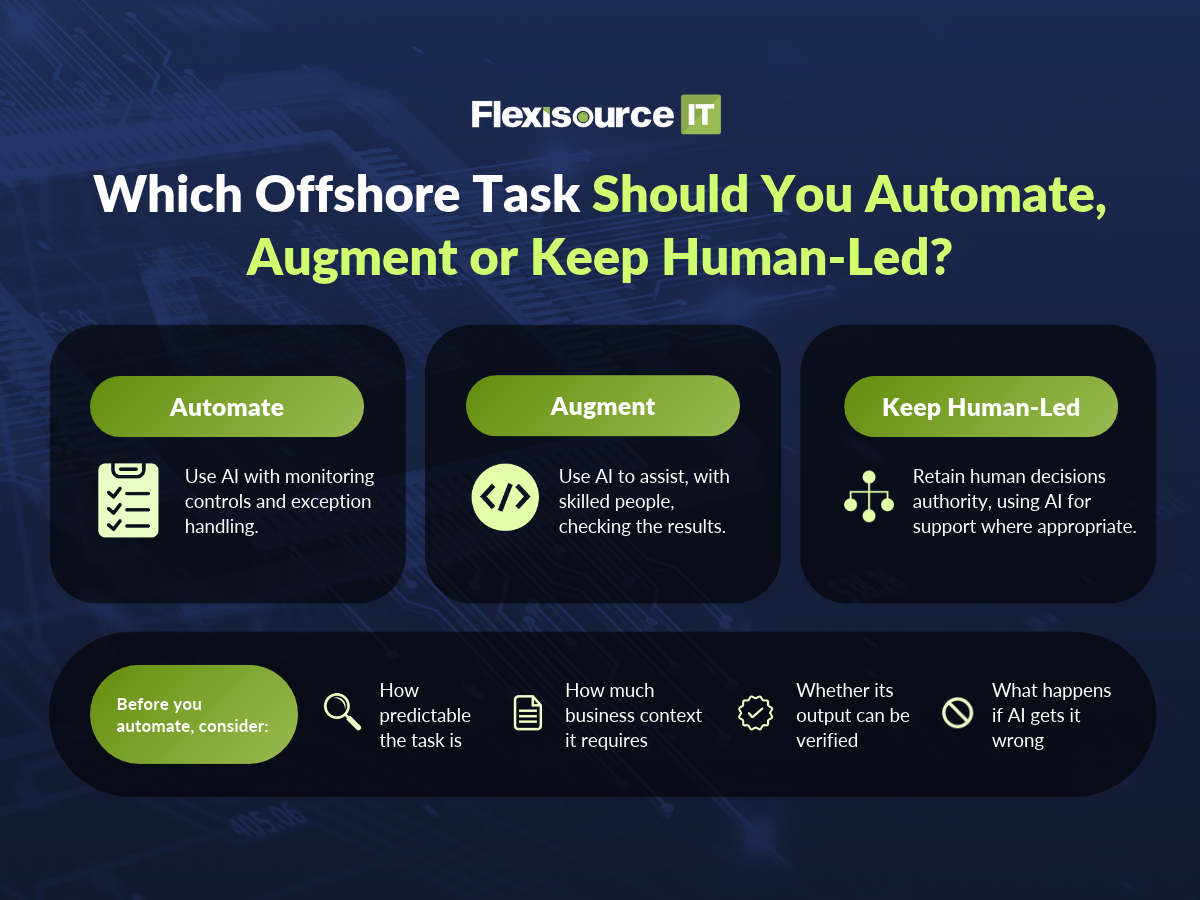
Which Offshore Tasks Should You Automate, Augment or Keep Human-Led?
Businesses should assess individual workflows rather than assume an entire role can be automated.
The following framework provides a practical starting point.
| Decision | Suitable Tasks | Recommended Approach |
| Automate | Predictable, repeatable, low-risk work | Use AI with monitoring, controls and exception handling |
| Augment | Coding, testing, troubleshooting and technical analysis | Use AI to assist, with skilled people checking the results |
| Keep human-led | Sensitive access decisions, major incidents, architecture and complex stakeholder issues | Retain human decision authority, using AI for support where appropriate |
Before automating an offshore workflow, consider how predictable the task is, how much business context it requires, whether its output can be verified and what happens if AI gets it wrong. A task that takes five minutes manually may not be worth automating if every result requires ten minutes of checking.
What AI Means for the Future of Offshore IT Teams
The future of IT outsourcing is likely to involve changing team structures as organisations automate some responsibilities and increase investment in others.
But the transition will not be identical across every business.
Fewer Repetitive Tasks, More Specialised Responsibilities
As routine activities become easier to automate, demand may shift towards complex troubleshooting, systems integration, cybersecurity, QA, AI workflow management and technical governance. This does not guarantee that every worker displaced from repetitive work will automatically move into a more specialised role.
Businesses need realistic plans for training, redeployment and changing staffing requirements.
Upskilling Becomes an Outsourcing Requirement
In outsourcing in the age of AI, technical qualifications alone may not be enough.
Offshore professionals also need to understand how to use AI tools appropriately, verify outputs, recognise limitations and protect client information.
For Australian businesses, this makes ongoing skills development an important consideration when evaluating outsourcing partners.
Human-AI Teams Need Clearer Ownership
Automating a task does not remove responsibility for its outcome.
Businesses still need to define who approves changes, handles exceptions, checks quality and responds when an automated workflow fails. These responsibilities should be agreed upon before AI becomes part of everyday delivery.
How Should Australian Businesses Evaluate AI-Enabled Outsourcing?
The best outsourcing partner is not necessarily the one claiming to automate the most work. It is the one that can demonstrate where AI adds value and where experienced professionals remain essential.
Ask What the Vendor Has Actually Automated
Ask providers to identify specific workflows where AI is used. Request evidence of how the process works, what requires human review and how errors are managed. Vague claims about AI-powered productivity are less useful than demonstrated improvements in an actual workflow.
Measure Outcomes, Not Just AI Usage
Track whether AI improves completed work, quality and operating costs.
For example, useful measures include cost per successfully resolved ticket, development cycle time, rework, defect rates and customer satisfaction.
More AI-generated output does not automatically mean better results. To measure AI performance in software engineering, businesses should look beyond code volume and track delivery speed, defect rates, rework and overall software quality.
Clarify AI Governance and Data Security
Before choosing a provider, confirm which AI tools employees can use, what client information may be entered into them and who approves AI-assisted work. The same applies to recruitment and workforce management.
Our guide to ethical AI hiring explains why human oversight, privacy and technical skills validation matter during vendor evaluation.
Review How AI Changes Outsourcing Costs
AI can reduce manual effort, but it also introduces costs for licences, integration, monitoring, validation, security and maintenance. Buyers should compare the total cost of delivering an acceptable result, not simply the number of labour hours eliminated.
Contract terms may also need to reflect changing responsibilities, including who maintains automation, handles failures and owns the resulting work.
How Flexisource IT Supports the Changing Future of IT Outsourcing
At Flexisource IT, we help Australian businesses access skilled offshore professionals across software development, quality assurance and IT support. As AI changes the way technical work is performed, businesses need teams that can adapt to new tools and responsibilities while maintaining quality and accountability.
Skilled Offshore Professionals for Evolving IT Roles
Our IT services support businesses looking for development, testing and technical expertise aligned with their requirements. The goal is to match the work with the right skills rather than assume every activity needs the same staffing approach.
Dedicated Teams That Work Within Your Processes
Offshore professionals should understand your systems, communication expectations, review requirements and business priorities. This becomes especially important when AI-assisted work requires shared technical context and consistent oversight.
Flexible Staffing as Workloads Change
Automation may reduce some manual responsibilities while increasing demand for testing, integration, specialist support or governance. A flexible offshore staffing model allows businesses to reassess capacity as those requirements evolve.
Final Thoughts: The Future of IT Outsourcing Is About Redesigning Work
AI will replace some offshore tasks, change others and leave important responsibilities requiring human expertise. The future of IT outsourcing is not simply about choosing between people and automation. It is about understanding which work AI can perform reliably and where skilled professionals continue to deliver value.
For Australian businesses, the strongest approach is to build offshore teams around actual delivery needs, clear accountability and measurable results.
Looking for an offshore IT team that can adapt as technology changes? Contact Flexisource IT to discuss software development, QA and IT support staffing suited to your business.