AI coding assistants are making code reviews harder, not easier. While these tools can generate code in seconds and accelerate development, they also increase the amount of code entering review, making it more difficult for engineers to verify quality, business logic and long-term maintainability.
At Flexisource IT, we’ve seen how AI is changing software development. The most successful engineering teams aren’t replacing human expertise with AI. They’re combining AI-powered productivity with experienced offshore developers who understand your coding standards, architecture and business objectives.
Why AI Is Changing the Code Review Process
AI coding assistants have transformed how developers write software. Tasks that once took hours can now be completed in minutes with tools that generate functions, suggest code completions and even create entire components.
While this improves productivity, it also changes the role of code reviews. Instead of reviewing smaller, carefully written code changes, engineering teams are increasingly reviewing larger pull requests generated with AI assistance. The focus shifts from checking syntax and formatting to validating whether the implementation is accurate, maintainable and aligned with business requirements.
For organisations embracing AI and offshore development, this means code review is becoming one of the most important quality assurance activities in the software development lifecycle.
AI Writes Code Faster Than Humans Can Review It
One of the biggest changes AI introduces is the speed at which code is produced. Developers can now generate working code much faster than before, increasing the number and size of pull requests moving through the development pipeline.
While faster development is generally positive, reviewers still need time to understand what the code does, evaluate design decisions and identify potential issues. As AI accelerates code generation, review capacity often becomes the new bottleneck.
This is particularly noticeable in distributed engineering environments, where reviewers must carefully assess AI-generated code before it reaches production. Larger pull requests also increase cognitive load, making it easier to overlook subtle bugs or architectural inconsistencies.
Code That Looks Correct Isn’t Always Correct
One of the challenges with AI-generated code is that it often appears well written, even when it contains hidden issues. Clean formatting and syntactically correct code do not guarantee that an implementation meets business requirements or handles real-world scenarios appropriately.
Reviewers must still verify that the code:
This means reviewers spend less time checking syntax and more time validating the reasoning behind the implementation. AI can generate code quickly, but determining whether that code is appropriate for a specific project remains a human responsibility.
Why Offshore Teams Feel This Shift First
Offshore software development has always relied on clear communication, shared standards and structured review processes. AI coding assistants don’t eliminate these requirements. In many cases, they make them even more important.
When developers can produce more code in less time, engineering teams need consistent review practices to maintain quality across different locations and time zones. This is why organisations investing in AI in IT outsourcing are also strengthening documentation, collaboration and review workflows.
Read: Offshore Developers vs In-House Developers: Pros and Cons
AI Increases the Need for Shared Context
AI can generate code based on prompts, existing files and publicly available patterns, but it doesn’t understand the unique context behind your product. It cannot fully interpret internal business rules, customer expectations or the technical decisions that shape your software over time.
For offshore teams, shared context is essential. Developers need a clear understanding of:
- Business objectives and user requirements.
- Internal coding standards.
- System architecture.
- Project-specific workflows.
- Team conventions and documentation.
Without this context, AI-generated code may technically work while still creating inconsistencies that increase technical debt or complicate future development.
Reviewers Must Validate Intent, Not Just Syntax
Modern code reviews involve much more than checking whether code compiles or follows style guidelines. As AI becomes more common, reviewers increasingly focus on whether the implementation is the right solution rather than simply a working solution.
This includes questions such as:
- Does the code solve the correct business problem?
- Is it consistent with the existing architecture?
- Will it remain maintainable as the application grows?
- Does it introduce unnecessary complexity?
- Does it follow established engineering standards?
These reviews require experience, judgement and an understanding of the broader project. AI can generate code, but it cannot replace the human insight needed to evaluate how that code fits within the larger software ecosystem.
The New Challenges of AI in Software Development Teams
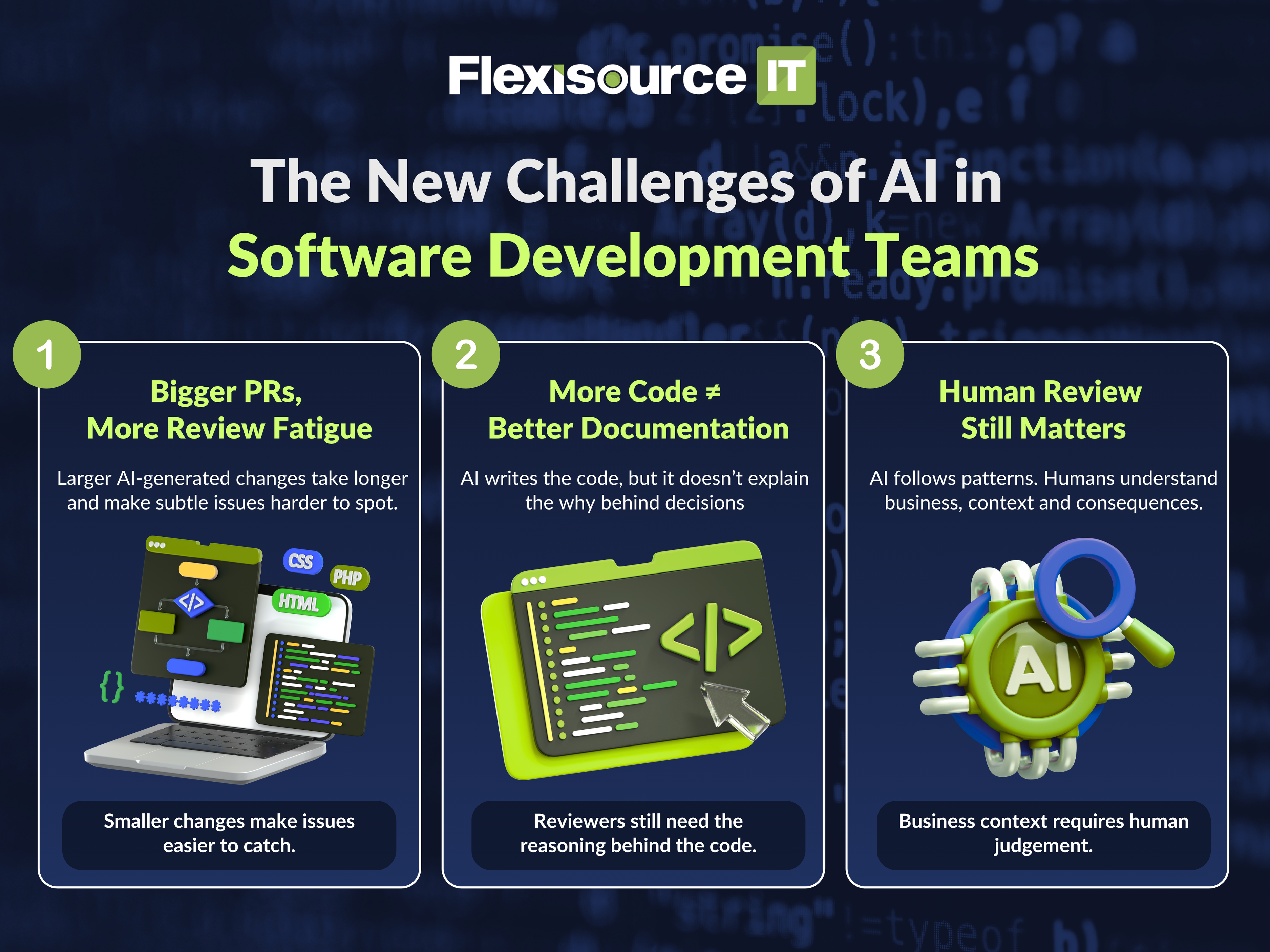
As more organisations adopt AI coding assistants, engineering leaders are discovering that faster code generation creates new operational challenges. The goal is no longer simply writing code more quickly, but ensuring that increased development speed doesn’t reduce software quality or create additional work during reviews.
Larger Pull Requests Create More Review Fatigue
AI makes it easier for developers to generate larger blocks of code in a single session. While this can improve productivity, it often results in bigger pull requests that require significantly more time and concentration to review.
Longer reviews increase cognitive load and make it harder to spot subtle issues, especially when multiple files or interconnected components are involved. Breaking work into smaller, focused pull requests remains one of the most effective ways to maintain review quality while benefiting from AI-assisted development.
More Code Doesn’t Mean Better Documentation
AI can generate functional code quickly, but it doesn’t automatically explain why certain decisions were made. Developers may receive well-structured code without the context that helps future team members understand design choices, trade-offs or business logic.
For reviewers, this creates additional work. Instead of simply checking the implementation, they often need to ask questions about why the code was written a certain way or how it supports the intended functionality. Without clear documentation, even high-quality code becomes harder to maintain over time.
Engineering teams can reduce this problem by encouraging developers to document AI-assisted changes, explain key decisions in pull requests and provide enough context for reviewers to evaluate the implementation efficiently.
Human Review Still Catches What AI Misses
AI coding assistants are trained to recognise patterns, generate suggestions and automate repetitive development tasks. However, they don’t fully understand the broader business context behind every application.
Experienced reviewers continue to identify issues that AI may overlook, including:
- Business rules that aren’t reflected in the prompt.
- Edge cases that only appear in real-world scenarios.
- Architectural decisions that affect long-term scalability.
- Performance trade-offs between different implementation options.
- Security considerations specific to the application.
This is why AI in software development teams works best when AI supports developers rather than replacing engineering judgement. Human expertise remains essential for ensuring software is reliable, maintainable and aligned with business objectives.
Best Practices for AI and Offshore Development
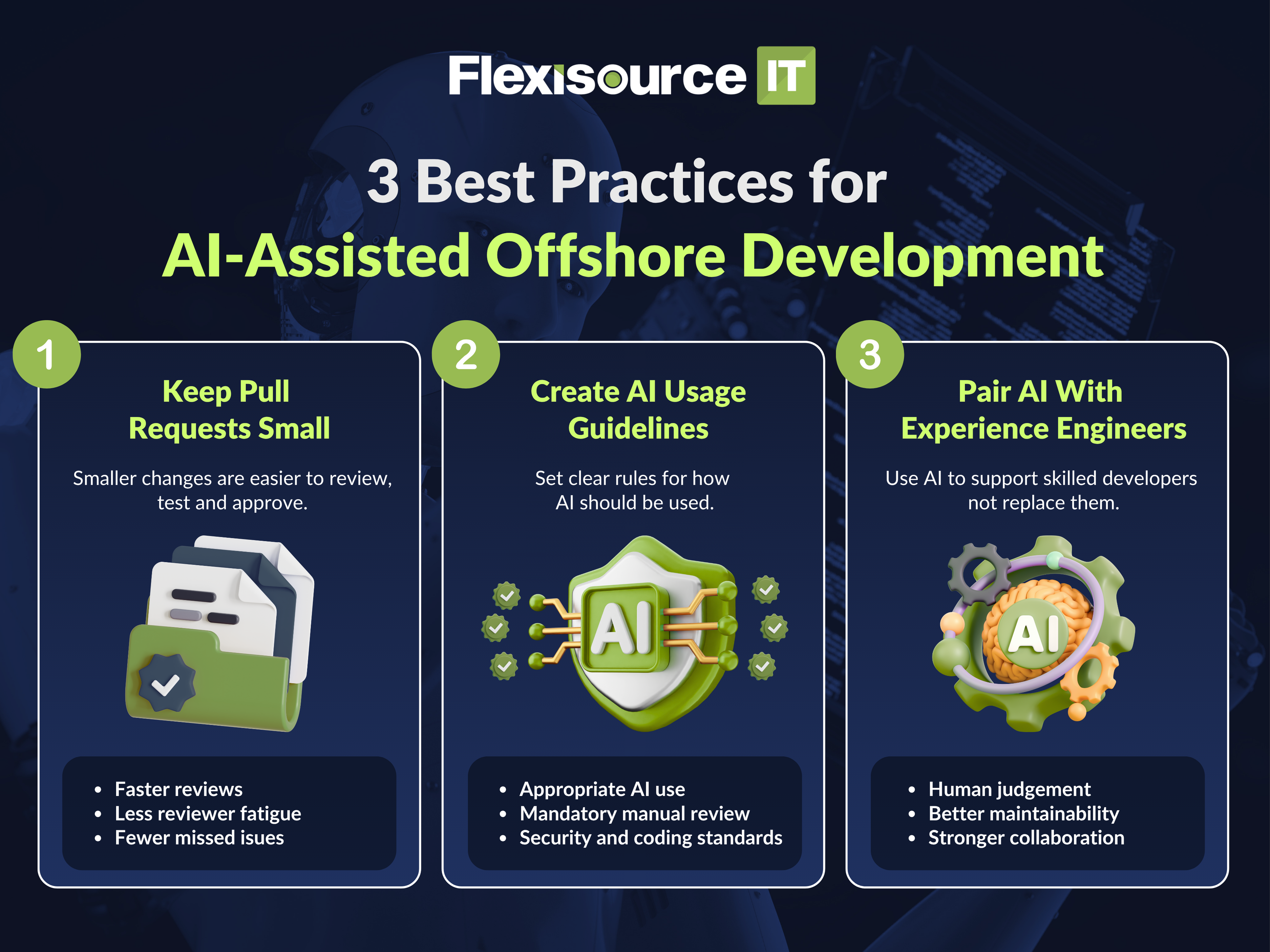
AI coding assistants are most effective when they’re introduced alongside clear engineering processes rather than treated as a replacement for them. Organisations that combine AI with strong review practices are better positioned to improve productivity while maintaining software quality.
Keep Pull Requests Small
Smaller pull requests are easier to review, easier to test and less likely to introduce unnoticed issues. Even when AI generates larger amounts of code, developers should aim to break changes into focused, logical units wherever possible.
Smaller reviews help engineering teams:
- Reduce reviewer fatigue.
- Identify issues more quickly.
- Improve collaboration across distributed teams.
- Accelerate feedback without sacrificing quality.
This approach is particularly valuable for offshore teams working across multiple time zones, where faster review cycles help keep projects moving.
Create AI Usage Guidelines
As AI becomes part of everyday development, teams benefit from establishing clear expectations around how coding assistants should be used.
Guidelines might include:
- Which development tasks are appropriate for AI assistance.
- When manual review is mandatory.
- Documentation requirements for AI-generated code.
- Security and compliance checks before deployment.
- Coding standards that AI-generated code must follow.
Clear governance helps engineering teams use AI consistently while reducing uncertainty during reviews.
Pair AI With Experienced Engineers
AI is most valuable when it enhances the capabilities of experienced developers rather than attempting to replace them. Skilled engineers understand business requirements, system architecture and long-term maintainability in ways that AI cannot.
In AI and offshore development, experienced offshore developers also bring collaboration, communication and domain knowledge that improve the overall development process. Combined with AI coding assistants, they can deliver software more efficiently without compromising quality or consistency.
How Flexisource IT Helps Engineering Teams Use AI Effectively
At Flexisource IT, we believe AI should strengthen software development, not create new risks. Our offshore developers use modern AI tools responsibly while following structured engineering practices that prioritise quality, collaboration and maintainability.
Experienced Offshore Developers Who Understand AI-Assisted Workflows
Our developers understand how to incorporate AI into everyday development without relying on it blindly. They validate AI-generated code, follow your engineering standards and ensure every implementation aligns with your business objectives.
Review Processes Built Around Code Quality
Effective code reviews remain one of the most important safeguards in modern software development. Our teams follow structured review processes that focus on maintainability, architecture, business logic and long-term software quality, not just whether code compiles successfully.
Flexible Teams That Adapt to Your Engineering Standards
Every organisation has its own development workflows, coding standards and review processes. Our offshore teams integrate seamlessly with your existing engineering practices, using AI where it adds value while maintaining the consistency and quality your projects require.
In Reality: AI Makes Code Reviews More Important, Not Less
AI coding assistants are changing software development, but they aren’t eliminating the need for careful code reviews. As code generation becomes faster, the responsibility of reviewing, validating and maintaining that code becomes even more important.
Successful organisations recognise that AI and offshore development isn’t about replacing engineers. It’s about combining AI-powered productivity with experienced developers who understand architecture, business context and long-term software quality.
At Flexisource IT, we help businesses build offshore development teams that use AI responsibly while maintaining high engineering standards. Contact us today to learn how our experienced developers can help you accelerate software delivery without compromising code quality.
Read next: