
The better question is not, “How many tickets did the team close?”
It should be, “Are users getting faster, clearer and more reliable support?”
For businesses evaluating outsourced IT support Australia, strong helpdesk performance should be measured through resolution quality, response consistency, user experience, escalation control, documentation and issue prevention.
At Flexisource IT, we help businesses build offshore helpdesk teams that focus on outcomes, not just ticket counts.
Why Does Ticket Volume Give an Incomplete Picture?
Ticket volume is not useless. It can show how much demand your helpdesk is handling and whether support requests are increasing or decreasing over time. However, it should not be treated as the main measure of performance.
A high ticket count might look impressive in a monthly report, but it does not always mean the helpdesk is working well. It may mean the business has recurring IT issues, unclear processes, poor self-service options or unresolved problems that keep coming back.
For IT managers, this matters because ticket volume can hide deeper performance issues. A vendor may appear busy and productive while users are still waiting too long, receiving unclear answers or logging the same problem again a week later.
More Closed Tickets Does Not Always Mean Better Support
Closing more tickets does not automatically mean users are receiving better support. In some cases, high ticket volume can point to weak service quality rather than strong performance.
For example, if employees keep submitting the same password, access, device or application issues, the helpdesk may be treating symptoms instead of solving the root cause. The team may be closing each request quickly, but the underlying problem remains.
This is where ticket volume becomes misleading. It measures how many requests were processed, but not whether those requests were handled well.
A better helpdesk should help reduce avoidable tickets over time by improving documentation, identifying recurring issues and supporting better user education.
Ticket Volume Rewards Speed Over Quality
When ticket volume becomes the main KPI, support teams may feel pressured to close tickets quickly rather than resolve them properly. This can lead to rushed responses, incomplete fixes or tickets being closed before the user has confirmed the issue is solved.
That creates a false sense of progress.
On paper, the numbers look good. In reality, users may still be frustrated, and IT managers may face more follow-up requests, escalations and complaints.
This is especially important in helpdesk outsourcing Australia, where external or offshore support teams must be measured by the quality of service they provide, not just the amount of work they process.
The Metrics That Actually Show Helpdesk Performance
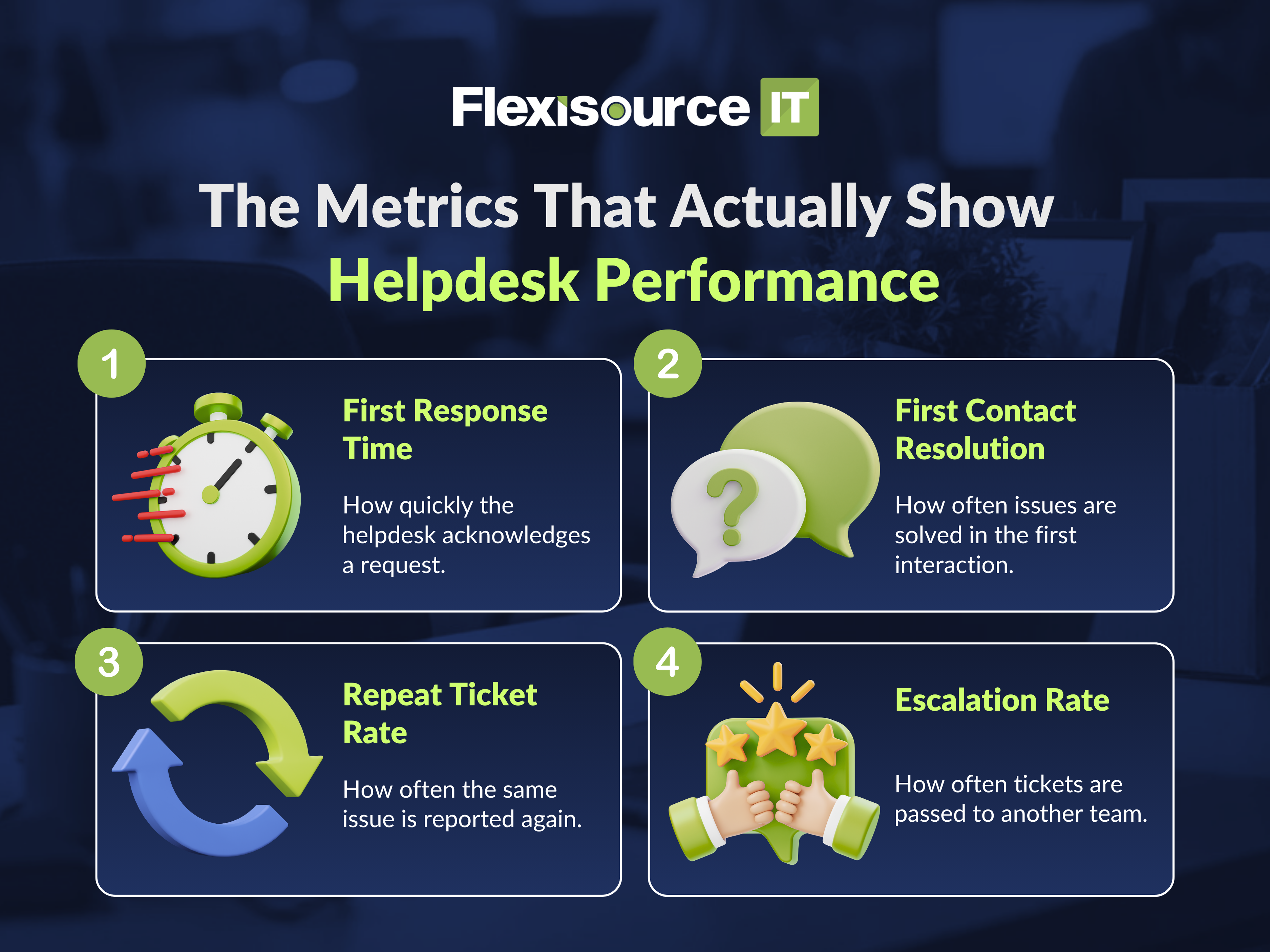
A strong offshore helpdesk should be measured through a balanced set of metrics. Ticket volume can still be included, but it should sit alongside indicators that show speed, quality, consistency and user experience.
The goal is to understand whether the helpdesk is helping the business operate smoothly, not just whether tickets are moving through a queue.
First Response Time
First response time measures how quickly the helpdesk acknowledges a request after it is submitted. This matters because users want to know their issue has been received and someone is looking at it.
Fast response times can reduce frustration, especially for urgent problems that affect productivity. However, speed alone is not enough. A quick response that simply says “we are checking” does not mean the issue is being resolved effectively.
IT managers should review first response time by priority level. A critical outage should not be measured the same way as a low-priority software question.
First Contact Resolution
First contact resolution measures how often the helpdesk resolves a user’s issue during the first interaction, without needing multiple follow-ups or escalations.
This is one of the most useful helpdesk metrics because it shows whether the team has the skills, access and knowledge needed to solve common problems properly.
A strong first contact resolution rate usually means:
- Users are receiving clear support.
- Helpdesk agents understand common issues.
- Internal documentation is useful.
- The team has enough system access to resolve requests.
- Escalations are being used appropriately.
For businesses using remote IT support services, this metric is especially important because users need confidence that offshore support can solve problems without unnecessary delays.
Repeat Ticket Rate
Repeat ticket rate measures how often the same issue is reported again by the same user, team or department. This metric helps IT managers identify whether the helpdesk is solving problems properly or only applying temporary fixes.
For example, if employees keep raising tickets about the same application error, device issue or account access problem, the team should investigate why it keeps happening.
Repeat tickets can reveal:
- Gaps in documentation
- Poor user guidance
- Unresolved technical issues
- Weak root cause analysis
- Problems with internal systems or tools
A good offshore helpdesk should not only respond to repeat issues. It should help reduce them.
Escalation Rate
Escalation rate measures how often helpdesk tickets are passed to another team, such as internal IT, security, network support or application specialists.
Escalations are not always bad. Some issues should be escalated because they require higher-level access, specialised expertise or business approval.
The problem is unnecessary escalation. If too many basic tickets are being passed along, it may show that the helpdesk team lacks training, permissions, documentation or process clarity.
IT managers should look at both escalation volume and escalation quality. A strong helpdesk knows what it can resolve directly and when it needs to involve the right internal stakeholder.
Measuring User Experience, Not Just Helpdesk Activity
Helpdesk performance should also be measured from the user’s point of view. A ticket may be marked as resolved, but that does not always mean the user felt supported.
This is where user experience metrics become important. They help IT managers understand whether the helpdesk is clear, helpful and easy to work with.
Customer Satisfaction Scores
Customer satisfaction scores, often called CSAT, ask users to rate their support experience after a ticket is handled. This gives IT managers direct feedback on whether users feel the helpdesk met their needs.
CSAT can reveal issues that ticket numbers cannot. For example, a ticket may be closed within the agreed timeframe, but the user may still rate the experience poorly because the response was confusing, slow to explain or not helpful enough.
This makes CSAT a useful quality check for any business evaluating outsourced IT support Australia providers.
User Effort Score
User effort score measures how easy or difficult it was for someone to get help. This matters because employees do not just want their issue resolved. They want the support process to feel simple.
A user may become frustrated if they need to explain the same issue multiple times, follow unclear instructions or wait for several handoffs before receiving help.
A strong offshore helpdesk should make support feel easier, not more complicated. That means clear communication, simple instructions and fewer unnecessary steps.
What Good Helpdesk Outsourcing Australia Should Track
Good helpdesk reporting should show more than how many tickets were opened or closed. For businesses evaluating helpdesk outsourcing Australia, the most useful reports connect support activity to business impact.
That means tracking whether urgent issues are handled quickly, common problems are being reduced and users are receiving consistent support.
SLA Performance by Priority Level
Service level agreements should be measured by priority. A system outage, security issue or major access problem should have a different response target from a general software question.
Useful SLA reporting should show:
- Response time by priority
- Resolution time by priority
- Missed SLA reasons
- Escalation patterns
- Recurring high-priority issues
This gives IT managers a clearer view of whether the helpdesk is meeting business needs, not just closing tickets.
Documentation Quality
Strong documentation helps support teams resolve issues faster and more consistently. It also reduces dependence on individual agents.
A good offshore helpdesk should maintain:
- Clear ticket notes
- Updated troubleshooting guides
- Internal runbooks
- User-facing help articles
- Known issue records
When documentation improves, support becomes easier to scale and repeat issues become easier to manage.
Root Cause Insights
A helpdesk should not only react to problems. It should also help identify why problems keep happening.
If the same application, device or access issue appears every week, that is useful information for IT leaders. A strong helpdesk vendor should report these patterns and help the business decide what needs to change.
This turns helpdesk data into practical insight, not just a monthly ticket summary.
How Remote IT Support Services Should Support Business Continuity
Reliable remote IT support services should help employees stay productive, even when IT teams are stretched or working across different locations.
Business continuity depends on more than fast replies. It also requires clear escalation paths, consistent coverage and reporting that helps managers see risks early.
Availability Across Time Zones
Offshore support can give businesses extended coverage without placing extra pressure on internal teams. This is especially useful for companies with hybrid staff, multiple offices or after-hours support needs.
However, availability should be clearly defined. IT managers should know when support is active, which issues are covered and how urgent requests are handled outside normal business hours.
Clear Escalation Paths
A good helpdesk knows which issues it can resolve directly and which ones need internal approval or specialist support.
Clear escalation paths prevent delays and confusion. They also help offshore teams work smoothly with internal IT, security, infrastructure and application teams.
Reports should help IT managers understand service quality, not just activity levels. Instead of showing only ticket totals, reporting should highlight: This makes helpdesk reporting more useful for planning and improvement.Reporting That Helps IT Leaders Make Decisions
Moving Beyond Ticket Volume: A Balanced Scorecard for Helpdesks
Ticket volume can still be useful, but it should never be the main measure of helpdesk success. IT managers need a balanced scorecard that measures speed, quality, user experience and prevention.
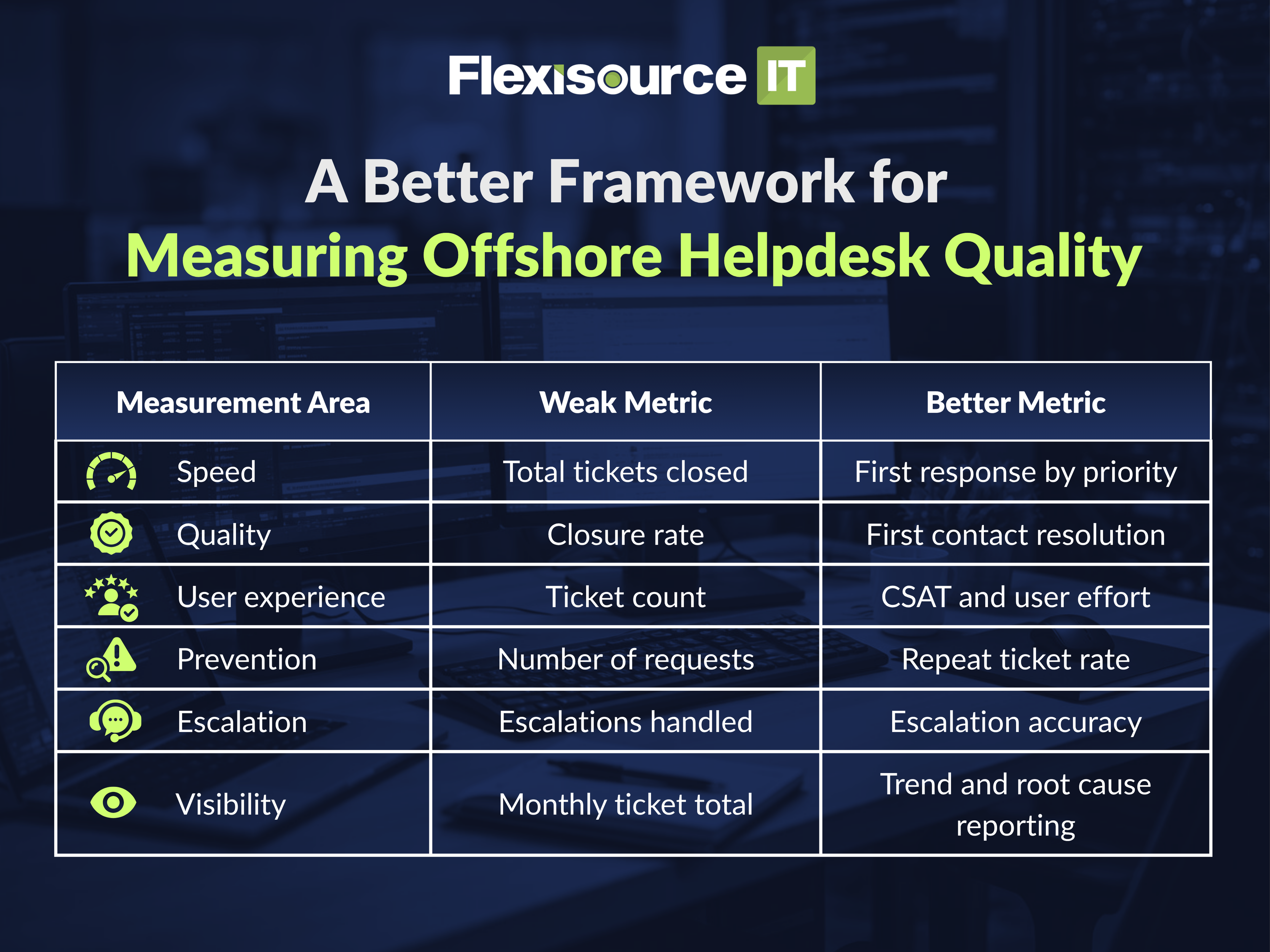
This framework gives a clearer picture of whether the helpdesk is actually improving support outcomes.
How Flexisource IT Measures What Matters
At Flexisource IT, we help businesses build offshore helpdesk teams focused on practical outcomes. Our approach to outsourced IT support Australia is built around reliable service, clear communication and reporting that helps IT leaders make better decisions.
Support Teams Built Around Outcomes
Our offshore support teams focus on helping users resolve issues quickly and clearly. The goal is not just to process tickets, but to improve the support experience and reduce avoidable problems over time.
Transparent Performance Reporting
Flexisource IT supports clear reporting across response times, resolution quality, escalation patterns and recurring issues. This gives IT managers better visibility into what is working and where support can improve.
Offshore Helpdesk Support That Fits Your Business
Every business has different tools, users and support requirements. Our offshore helpdesk teams can align with your systems, workflows and internal standards so support feels integrated rather than disconnected.
Final Thoughts: Measure Helpdesk Quality by Outcomes, Not Activity
Ticket volume is not useless, but it is not enough. A helpdesk can close many tickets and still fail to deliver good support.
For IT managers evaluating outsourced IT support Australia, the better question is whether users are getting faster, clearer and more reliable help. Strong helpdesk performance should be measured through response quality, first contact resolution, user experience, repeat issue reduction and useful reporting.
If you need a helpdesk partner that measures what actually matters, Flexisource IT can help. Contact us today to learn how our remote IT support services can improve support quality, visibility and user experience.
Read next: