
Before signing an IT support contract, do not only negotiate the size of the SLA penalty.
Negotiate what counts as a breach, when the SLA clock starts, whether targets apply to response or resolution, how service credits are calculated, what happens after repeated failures, and whether the provider must explain and fix recurring issues.
For businesses reviewing outsourced IT support Australia, this matters because a small service credit will not always protect you from downtime, frustrated users, delayed support, or repeated service issues. A stronger contract should make the support model clear before problems happen.
At Flexisource IT, we believe IT support agreements should be transparent, practical, and built around real business needs, not vague promises that are hard to enforce later.
Why SLA Penalty Clauses Are Often Weaker Than They Look
SLA penalty clauses can look reassuring in a contract. They suggest that if the provider misses a target, the client receives some kind of credit or remedy.
But in practice, the penalty is only as useful as the wording behind it.
If the agreement does not clearly define response times, resolution expectations, priority levels, exclusions, reporting, and repeated failure consequences, the penalty may not give you much practical protection. A weak SLA clause might technically offer a credit, but still leave the business dealing with slow support, unclear updates, or repeated problems.
A Service Credit Is Not the Same as Real Protection
A service credit usually reduces part of the monthly fee when the provider misses an agreed service level. That can be useful, but it should not be treated as the main protection in the contract.
For example, a small credit may not make up for:
- Lost employee productivity
- Customer disruption
- Delayed internal operations
- Repeated unresolved tickets
- Poor communication during incidents
- Business-critical systems being unavailable
This is why buyers should look beyond the discount. The stronger question you have to keep in mind is, “What happens operationally when support performance falls below the agreed standard?”
A good SLA should push the provider to fix the problem, explain what happened, and prevent the same issue from happening again.
Penalties Can Hide Weak Service Definitions
Some contracts use language that sounds reasonable but is too vague to protect the client properly.
Watch out for phrases like:
These phrases are not always bad, but they should not replace clear service commitments. If the contract does not define what support levels mean, it becomes harder to prove whether the provider missed the target.
For MSP helpdesk support, this is especially important because daily service quality depends on clear expectations. If “urgent” is not defined, or if response time starts only after the provider triages the ticket, the SLA may be weaker than it looks.
What to Negotiate Before You Sign
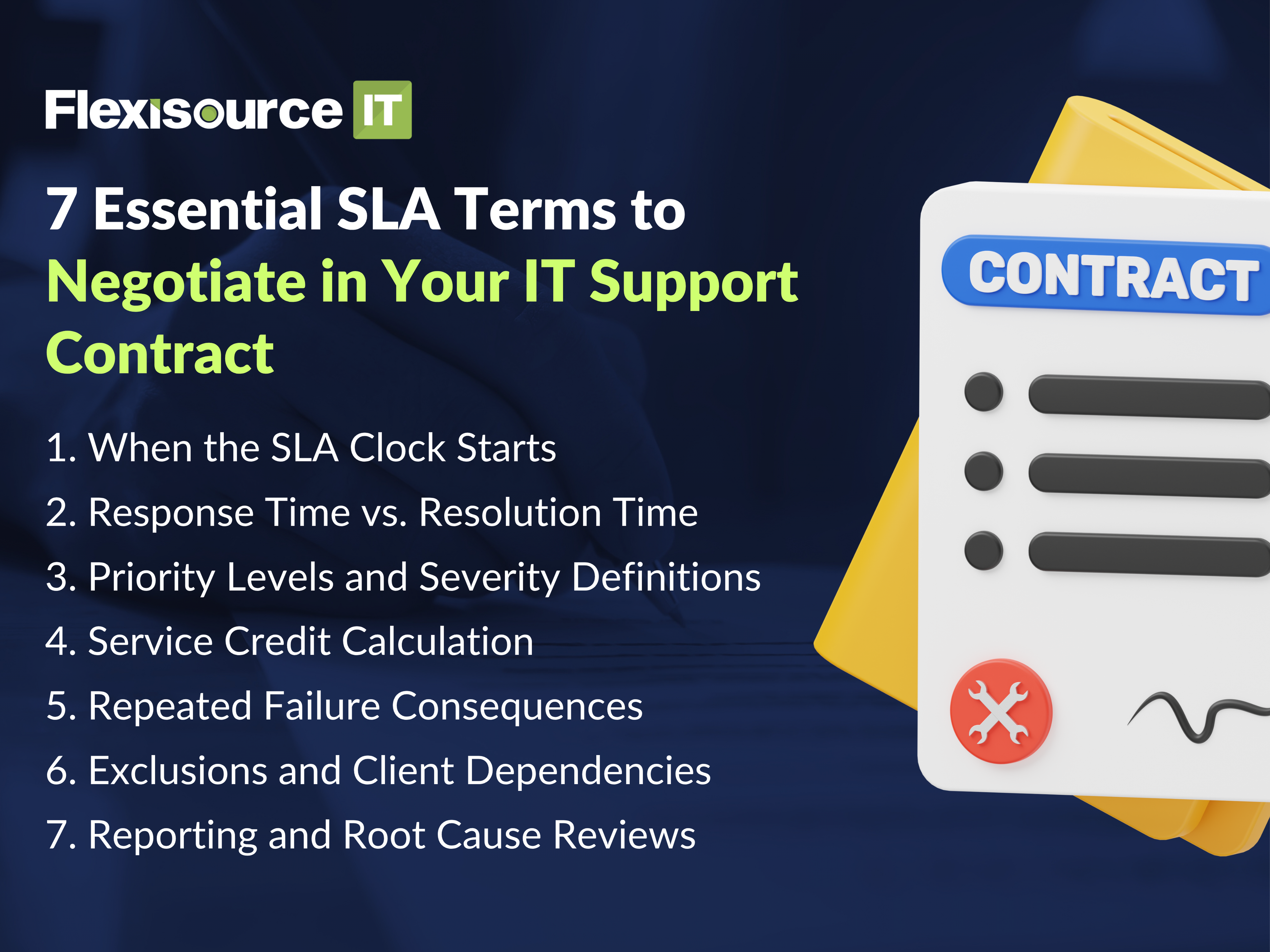
A strong IT support contract should explain how the SLA works in real situations. Before signing, buyers should review the following areas carefully.
1. When the SLA Clock Starts
One of the most important details is when the SLA timer begins.
Does it start when your user submits the ticket? When the helpdesk acknowledges it? When the ticket is triaged? Or only during business hours?
This matters because the provider may meet the SLA on paper while the user still waits too long in practice. A stronger agreement should clearly state when the clock starts for each priority level. If the clock only starts after provider triage, ask how quickly triage must happen.
2. Response Time vs. Resolution Time
The two are not the same thing.
Response time measures how quickly the provider acknowledges the issue. Resolution time measures how quickly the issue is fixed or brought to an agreed outcome.
A contract that only promises fast response may not be enough. A provider could respond quickly with “we are looking into it” but still take too long to resolve the issue.
For L1 IT support outsourcing, this distinction is critical. Frontline support may handle many common requests, but buyers should still know which issues can be resolved at L1, which need escalation, and how long each stage should take.
3. Priority Levels and Severity Definitions
Your contract should define priority levels clearly. A password reset should not be treated the same way as a business-wide outage.
Common priority levels may include:
- Critical outage
- Major business disruption
- Standard user issue
- Low-priority request or question
The agreement should also explain who decides severity. If only the provider can classify tickets, the client may have limited control when an issue feels urgent to the business. A stronger approach is to define severity based on business impact, affected users, system importance, and urgency. This helps avoid disputes when something goes wrong.
4. Service Credit Calculation
Service credits should be easy to understand before you sign. The contract should explain how credits are calculated, when they apply, whether they are capped, and whether the client must request them manually.
Buyers should check:
- Is the credit based on the monthly fee?
- Does the credit increase for repeated failures?
- Is there a maximum credit cap?
- Does the credit apply automatically?
- Are some services excluded?
A small credit may be acceptable for a minor issue. But for repeated SLA failures, the contract should offer more than a token discount.
5. Repeated Failure Consequences
One missed SLA may not be a major issue. Repeated failures are different.
If the provider consistently misses response or resolution targets, the contract should explain what happens next. This may include a service review, written improvement plan, senior escalation, additional reporting, or termination rights if the issue continues.
Without this wording, the client may receive small credits while the same support problems keep happening.
6. Exclusions and Client Dependencies
Every SLA should include reasonable exclusions. For example, the provider may not be responsible for delays caused by missing client access, third-party outages, unsupported systems, or incomplete information from the user.
However, exclusions should be specific and fair. Broad wording can make the SLA difficult to enforce.
Ask the provider to define:
- What is excluded
- Who decides whether an exclusion applies
- How excluded time is tracked
- What the client must provide for support to proceed
This helps prevent disputes when a ticket is delayed.
7. Reporting and Root Cause Reviews
SLA reporting should show more than ticket totals. Buyers should ask for reports that explain whether service standards are being met and where problems keep happening.
Useful reports should include:
- SLA performance by priority
- Missed SLA reasons
- Escalation patterns
- Repeat ticket trends
- Root cause findings
- Improvement actions
This turns the SLA into a management tool, not just a penalty clause.
What MSP Helpdesk Support Contracts Should Clarify
For MSP helpdesk support, the contract should clearly define what the provider handles, when support is available, and how users will be updated during incidents.
L1, L2, and Escalation Boundaries
The agreement should explain which issues are handled by L1 support, which go to L2 or L3, and when internal teams need to be involved. This matters because unclear escalation rules can delay fixes and frustrate users.
Coverage Hours and After-Hours Support
Clarify whether support is available during business hours, extended hours, weekends, public holidays, or emergencies. If after-hours support costs extra, that should be clear before signing.
Communication Standards During Incidents
During urgent issues, users and managers need updates. The contract should define how often updates are provided, who receives them, and what information is included.
Special Considerations for L1 IT Support Outsourcing
For L1 IT support outsourcing, buyers should be very clear about scope. L1 support often handles password resets, access requests, basic troubleshooting, ticket triage, and user guidance.
The contract should also define when L1 must escalate. For example, security issues, repeated errors, system outages, or requests requiring higher permissions should have clear escalation rules. Repetitive L1 tickets should also be reported. If users keep raising the same issue, the provider should help identify whether better documentation, training, automation, or system fixes are needed.
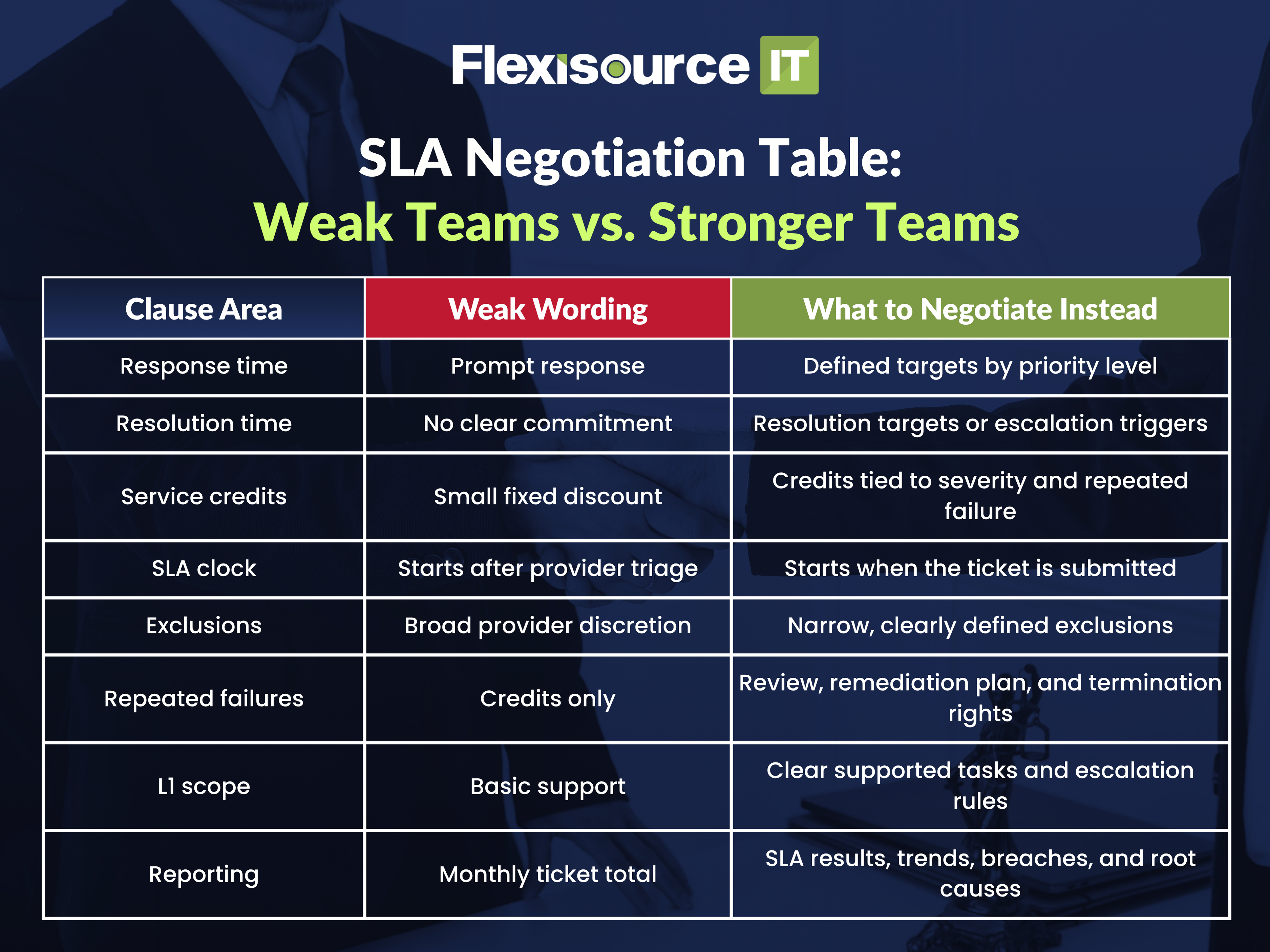
SLA Negotiation Table: Weak Terms vs. Stronger Terms
How Flexisource IT Supports Transparent IT Support Agreements
Flexisource IT helps businesses build support models with clear scope, practical reporting, and defined escalation processes.
Our approach to outsourced IT support Australia is built around clarity. We help clients understand what support is included, how issues are handled, and how performance is reported. Whether you need MSP helpdesk support or L1 IT support outsourcing, the goal should be the same: reliable support, clear communication, and fewer surprises after the contract is signed.
Final Thoughts: Negotiate the Service Model, Not Just the Penalty
A strong SLA penalty clause is not just about getting money back when something goes wrong. It is about making sure service expectations, escalation rights, reporting, and repeated-failure consequences are clear before support begins.
If you are reviewing an IT support agreement, focus on the operating details behind the penalty. That is where the real protection sits.
Looking for outsourced IT support in Australia with clear expectations and practical support models? Contact Flexisource IT to discuss MSP helpdesk support or L1 IT support outsourcing that fits your business.
Read next:
- How to Measure AI Performance in Software Engineering Article by: Joshua Inciso Posted: 29 September 2026
- AI Coding Assistants Are Making Offshore Code Reviews Harder, Not Easier. Here’s Why
- The Offboarding Clause Most Staff Augmentation Contracts Get Wrong
- Ticket Volume Is the Wrong Metric: How to Actually Measure a Good Offshore Helpdesk


