
For Australian startups, momentum can disappear just as quickly as it’s gained, which is why many founders are asking: what is adaptive software development, and how can it help teams move faster without building the wrong product?
Customer needs change quickly, new competitors appear overnight, budgets are tight, and pressure from investors is real. In this kind of environment, speed is everything, but smart speed matters even more.
In simple terms, adaptive software development comes down to this: it is a flexible way to build software that accepts change as normal, not as a problem. Instead of trying to plan everything upfront, teams build in short cycles, learn from real users, and adjust as they go. For startups, this approach is often the difference between growth and wasted spend.
This guide explains what adaptive software development is, how it works, and why it matters so much for Australian businesses right now. We will also show how Flexisource IT supports this approach through Scrum, Kanban, and fully timezone-aligned teams.
The Problem With Traditional Software Development
So, what is adaptive software development? To really understand that, it helps to first look at what does not work well for startups.
Traditional software projects often follow a “Waterfall” model. This means long planning phases, fixed scopes, and one big delivery at the end. Everything is decided early, before users touch the product. For large, stable organisations, this may still have some use. For startups, it is risky.
Markets move too fast. Customer feedback comes too late. By the time the product is ready, the business problem may have changed. This is why many startups abandon Waterfall and move towards agile software development, which focuses on flexibility and learning.
Adaptive Software Development is one of the early foundations of agile software development, and it remains very relevant today.
Read: What Is Software Development? An In-Depth Guide, Project Management and Agile Methodology: The Secret to Scaling Offshore Teams
What Is Adaptive Software Development?
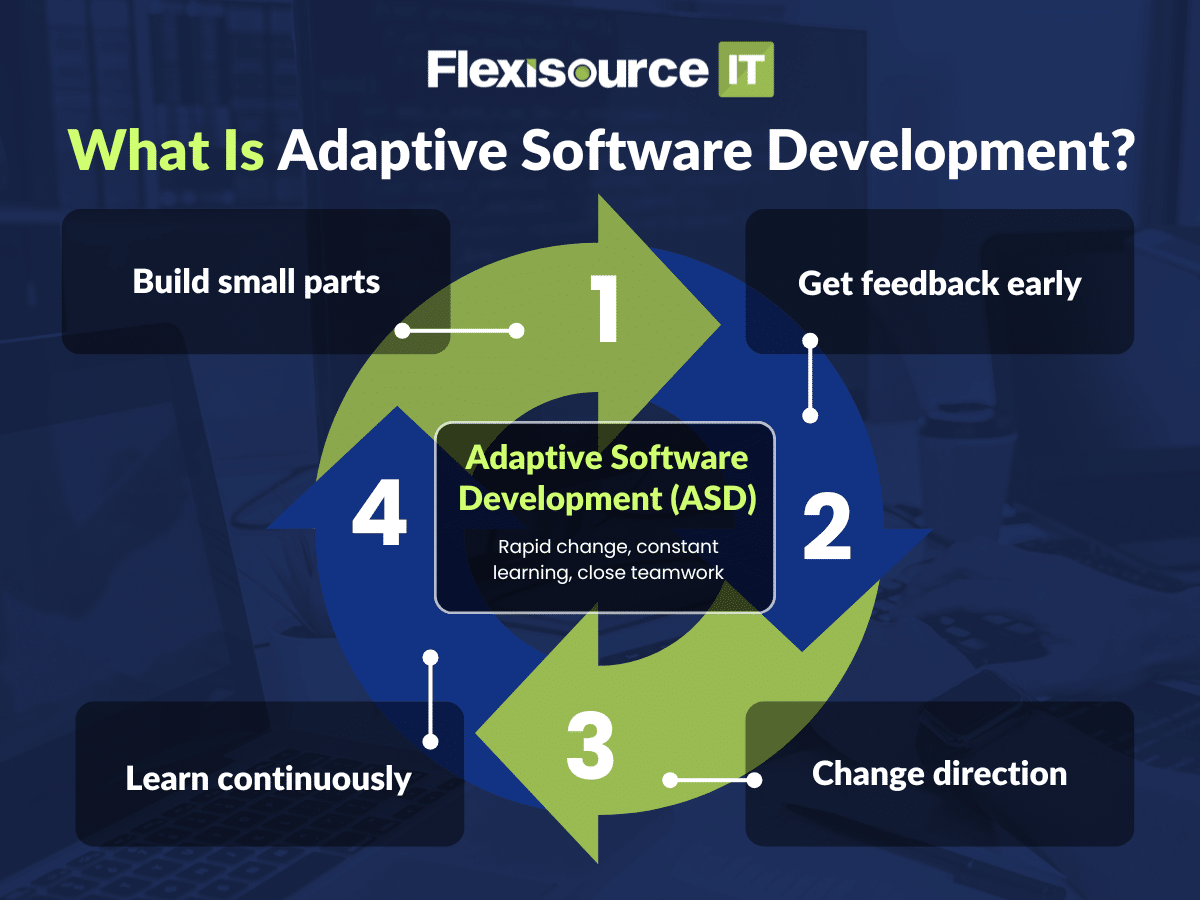
What is adaptive software development in clear and simple words?
Adaptive Software Development, often called ASD, is a framework that focuses on rapid change, constant learning, and close teamwork. It assumes that you cannot know everything at the start. Instead of fighting uncertainty, ASD works with it.
At its core, what is adaptive software development can be described as:
- Building software in small, usable parts
- Getting feedback early and often
- Changing direction when needed
- Learning continuously
This mindset fits naturally within agile software development, and many modern agile teams use ASD ideas every day without even naming them.
The benefits of adaptive software development are especially strong for startups. You reduce risk, avoid wasted effort, and stay close to what users actually want.
The Core Characteristics of Adaptive Software Development
To have a full grasp of what adaptive software development is, we need to look at its core characteristics. These principles shape how teams think and work.
Mission Focused
ASD is mission focused. The goal is not just to complete tasks or follow a plan. The goal is to solve the right problem. This matters because startups often pivot. What seemed important three months ago may no longer be the top priority. ASD allows teams to shift focus while still moving forward.
This is one of the key benefits of adaptive software development. Teams stay aligned to outcomes, not just checklists.
Feature Based
Instead of waiting months for a full product, ASD teams deliver features in small, working pieces. Each feature adds real value and can be tested by users. This approach fits well with agile software development, where progress is measured by working software, not documents.
Flexisource IT supports this through Scrum and Kanban. Scrum uses short cycles called sprints. Kanban focuses on steady flow and visibility. Both are practical ways to implement Adaptive Software Development in real projects.
Iterative
Iteration is central to ASD. Teams build, test, learn, and improve in short cycles. These cycles are very similar to the sprints used by Flexisource IT’s Scrum teams. Each cycle creates learning. Each cycle reduces uncertainty.
This is another reason why the benefits of adaptive software development are so strong. Problems surface early, when they are cheaper to fix.
The ASD Lifecycle: The “How-To”
The ASD lifecycle explains how Adaptive Software Development works in practice. It is simple, flexible, and repeatable.
The ASD lifecycle has three main phases: Speculate, Collaborate, and Learn. Together, they form a continuous loop.
Speculate
Speculate is essentially the planning phase. Unlike rigid planning, this phase accepts that plans will change.
Teams define goals, set priorities, and make educated guesses based on what they know now. The plan is clear, but flexible.
In the ASD lifecycle, speculation is about direction, not prediction. This is very different from Waterfall planning.
Collaborate
Collaboration is the heart of ASD. Developers, designers, product owners, and stakeholders work closely together.
This is where Flexisource IT provides a major advantage. Our teams are fully timezone aligned with Australian businesses. This makes real-time communication easy. Meetings, stand-ups, and problem-solving happen without delays.
For startups, this seamless collaboration removes friction during the Collaborate phase of the ASD lifecycle. It also supports agile outsourcing without losing control or visibility.
Learn
Learning is what makes ASD adaptive. Teams review results, measure outcomes, and listen to user feedback.
What worked? What failed? What should change next?
This learning feeds directly into the next cycle. Over time, the product improves and risk drops.
This feedback loop is one of the most powerful benefits of adaptive software development.
Why Australian Businesses Need This Now
Australian businesses face unique pressures. The market is competitive, talent is scarce, and cost control is critical.
This is where adaptive software development becomes more than a theory. It becomes a practical business strategy.
Cost Efficiency
Startups cannot afford to build the wrong thing. Every dollar matters.
ASD reduces waste by testing ideas early. Features that do not work are stopped quickly. Features that succeed are expanded. This is one of the clearest benefits of adaptive software development for founders and product leaders.
Speed to Market
Getting an MVP out fast is often the key to survival. Adaptive teams can release early versions, learn from users, and improve continuously. This speed aligns perfectly with agile software development, where fast feedback beats perfect planning.
The Talent Gap
Finding experienced agile professionals locally is hard. Demand is high, and costs are rising. This is why many companies explore agile outsourcing. When done well, it fills the talent gap without slowing delivery.
Flexisource IT supports this by offering a dedicated development team that is already trained in Scrum, Kanban, and adaptive ways of working.
How “Flexisourcing” Enables Adaptive Development
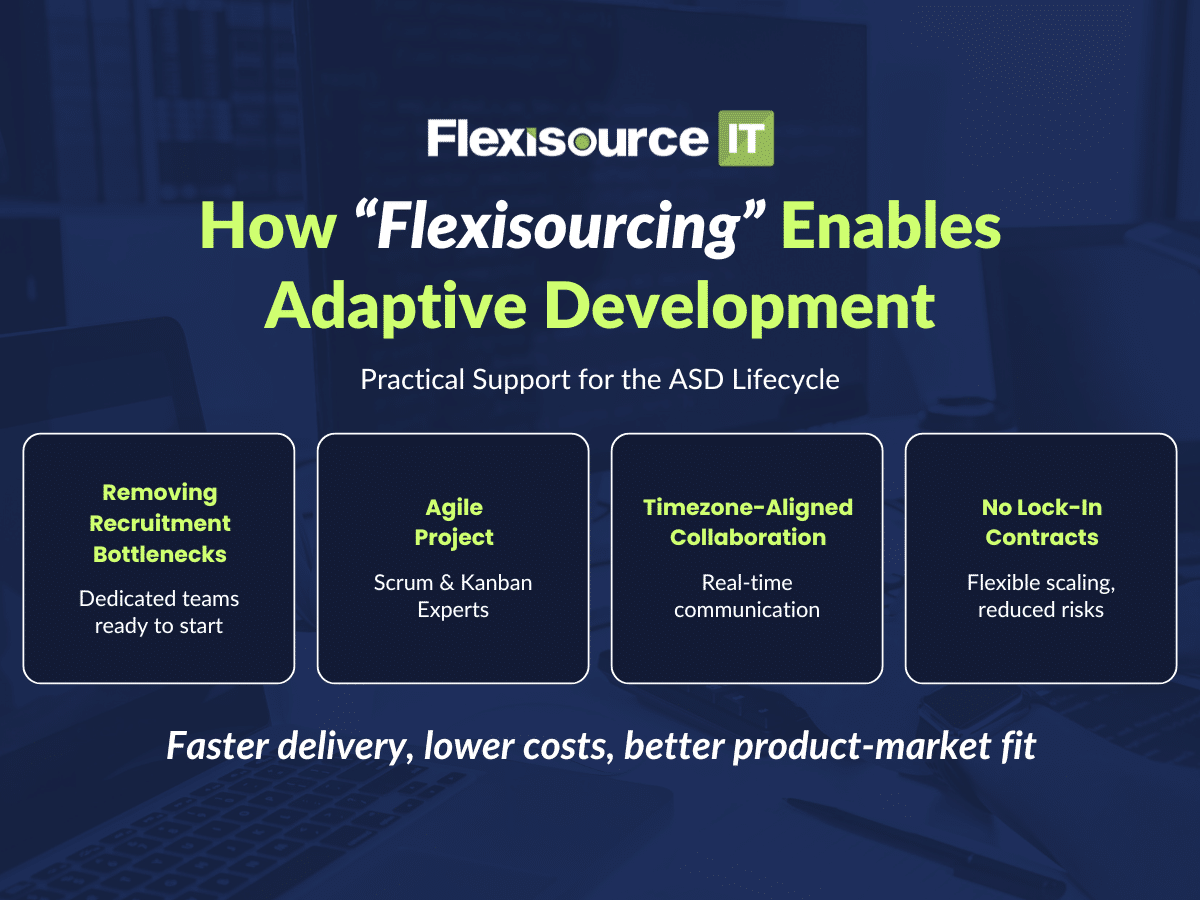
Adaptive Software Development sounds great in theory, but execution matters. You cannot be adaptive if your business is stuck in rigid contracts or slow hiring processes.
This is where Flexisource IT’s model supports real ASD adoption.
Removing Recruitment Bottlenecks
Hiring developers takes time. Interviews, onboarding, and training slow teams down.
Flexisource IT removes this friction by providing a dedicated development team that is ready to work. Our teams integrate directly with your business and follow your goals.
This supports both the ASD lifecycle and long-term scalability.
Agile Project Leadership
Flexisource IT provides Inclusive Agile Project Managers who understand both delivery and collaboration.
They help guide teams through Scrum and Kanban, which are practical ways to implement Adaptive Software Development.
This approach keeps agile software development focused on outcomes, not just process.
Timezone-Aligned Collaboration
One of the biggest risks in agile outsourcing is poor communication. Timezone gaps slow feedback and reduce trust.
Flexisource IT solves this by aligning teams with Australian business hours. This makes daily collaboration natural and effective, especially during the Collaborate phase of the ASD lifecycle.
No Lock-In Contracts
Adaptability should apply to business models too.
Flexisource IT offers no lock-in contracts. This reduces risk and allows companies to scale up or down as needs change. This is adaptive business in practice, not just theory.
Bringing It All Together
So, what is adaptive software development, and why does it matter?
It is a flexible, learning-driven approach that helps startups build the right product faster and with less risk. It fits naturally within agile software development and supports real-world change.
The benefits of adaptive software development include faster delivery, lower costs, and better alignment with users. The ASD lifecycle provides a clear but flexible structure. Agile outsourcing and a dedicated development team make it easier to apply ASD without hiring delays.
Flexisource IT specialises in Scrum and Kanban, the practical tools that bring Adaptive Software Development to life. With timezone-aligned teams, inclusive project managers, and no lock-in contracts, Australian businesses can truly stay adaptive.
Ready to Build Your Adaptive Team?
Adaptive Software Development is not just a trend. It is one of the best paths for sustainable growth in uncertain markets.
If you are ready to move faster, reduce risk, and stay close to your users, the next step is simple.
Ready to build your adaptive team? Scale fast with Flexisource IT’s dedicated developers by booking a consultation with us today.