
The DevOps vs. SRE decision is not about choosing which role is more important. Both support stronger engineering operations, but they solve different problems. DevOps helps teams release software faster and more consistently. SRE helps teams keep production systems stable, scalable and resilient.
For Australian tech teams, the right first hire depends on where the business feels the most pressure. At Flexisource IT, we help companies build offshore DevOps and SRE capability based on their current stage, systems and product roadmap.
DevOps vs. SRE: What Is the Real Difference?
DevOps and SRE are often discussed together because both roles sit between software engineering, infrastructure and operations. They both care about automation, performance, cloud systems and better engineering workflows.
However, they are not the same role.
DevOps focuses on improving how software moves from development to production. It helps teams reduce manual work, automate deployment processes and create more reliable delivery pipelines.
SRE, or Site Reliability Engineering, focuses on keeping production systems reliable once software is live. It helps teams manage uptime, incidents, monitoring, performance and long-term system resilience.
A simple way to think about it is this:
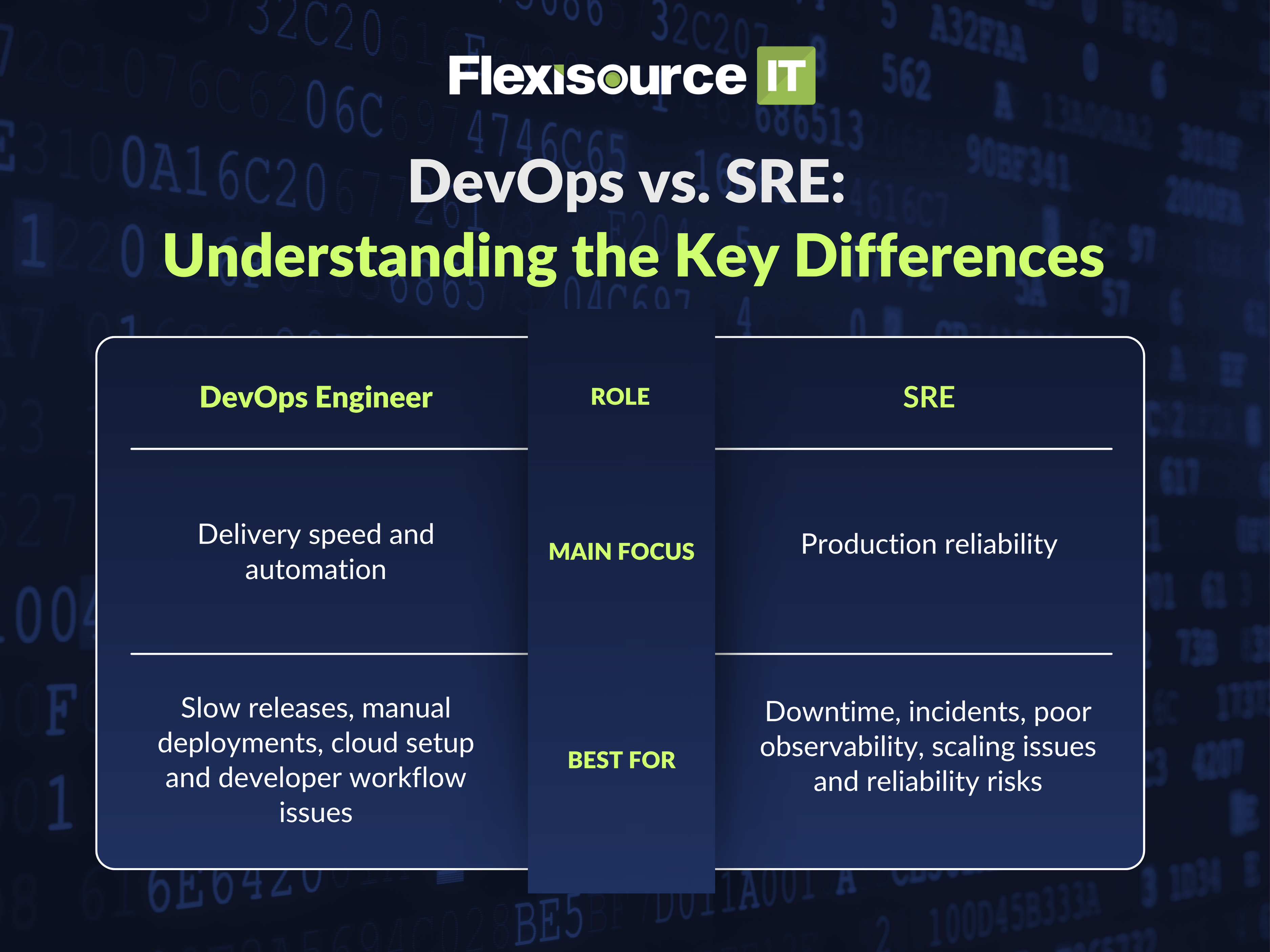
Both roles matter. The question is which problem your team needs to solve first.
What Does a DevOps Engineer Do?
A DevOps Engineer helps improve the systems and processes that allow software teams to build, test and release code more efficiently.
This often includes:
- Setting up CI/CD pipelines
- Automating deployment workflows
- Managing cloud infrastructure
- Improving development and staging environments
- Supporting infrastructure automation
- Reducing manual release work
- Helping developers ship code more consistently
For many teams, DevOps becomes necessary when releases feel slow, risky or unpredictable. Developers may spend too much time fixing environment issues, managing deployment scripts or waiting for manual approvals.
A dedicated DevOps engineer helps remove these bottlenecks. Instead of each developer handling infrastructure in different ways, the team gets clearer systems, repeatable workflows and stronger release practices.
For Australian businesses looking to improve delivery without expanding their local team too quickly, hiring an offshore DevOps engineer can be a practical way to add specialised support.
What Does a Site Reliability Engineer Do?
A Site Reliability Engineer focuses on keeping software systems reliable, available and scalable. While DevOps helps teams release software more smoothly, SRE helps ensure that software performs well once it is in production.
An SRE may work on:
- Monitoring and alerting
- Incident response
- Uptime and availability
- Performance issues
- Reliability targets
- Root cause analysis
- Capacity planning
- Production risk reduction
- Cloud reliability engineering
SRE becomes more important when a product is already live and downtime starts affecting customers, revenue or internal operations.
For example, if your team is constantly reacting to production incidents, missing early warning signs or struggling to understand why systems fail, it may be time to hire a Site Reliability Engineer.
Software reliability engineering is especially important for SaaS platforms, ecommerce systems, fintech products, internal business platforms and any digital service where downtime creates real business impact.
Read: What Is Shift-Left Testing in Software Development? Complete Guide for Agile & DevOps Teams
DevOps Engineer vs. SRE: Where the Roles Overlap
The DevOps engineer vs. SRE comparison can feel confusing because the roles share many tools and responsibilities. Both may work with cloud platforms, automation, deployment systems, monitoring tools and infrastructure.
The difference is not always the tools they use. It is the outcome they are responsible for improving.
A DevOps Engineer may build the pipeline that helps developers release code faster. An SRE may monitor how that release affects production reliability after deployment.
A DevOps Engineer may automate cloud infrastructure. An SRE may evaluate whether that infrastructure can handle real-world traffic, failure scenarios and future scaling needs.
They often work closely together, especially in growing engineering teams.
Both Roles Improve Engineering Efficiency
DevOps and SRE both help reduce friction in technical operations. They support developers, improve systems and make engineering work more reliable.
Both roles may help with:
This overlap is why smaller teams sometimes look for one person who can do both. In early-stage businesses, that can work for a while, especially if the product is still small and the infrastructure is manageable.
However, as the product grows, the responsibilities often become too large for one person to handle properly.
The Difference Is the Primary Outcome
The clearest difference between DevOps and SRE is the primary result each role is expected to deliver.
DevOps improves the way software is built, tested and deployed. It helps developers move faster with fewer release problems.
SRE improves the reliability of live systems. It helps the business reduce downtime, respond to incidents faster and build systems that can scale under pressure.
So, if your team keeps asking, “Why are deployments so slow?” you probably need DevOps first.
If your team keeps asking, “Why does production keep breaking?” you probably need SRE first.
When Should You Hire a DevOps Engineer First?
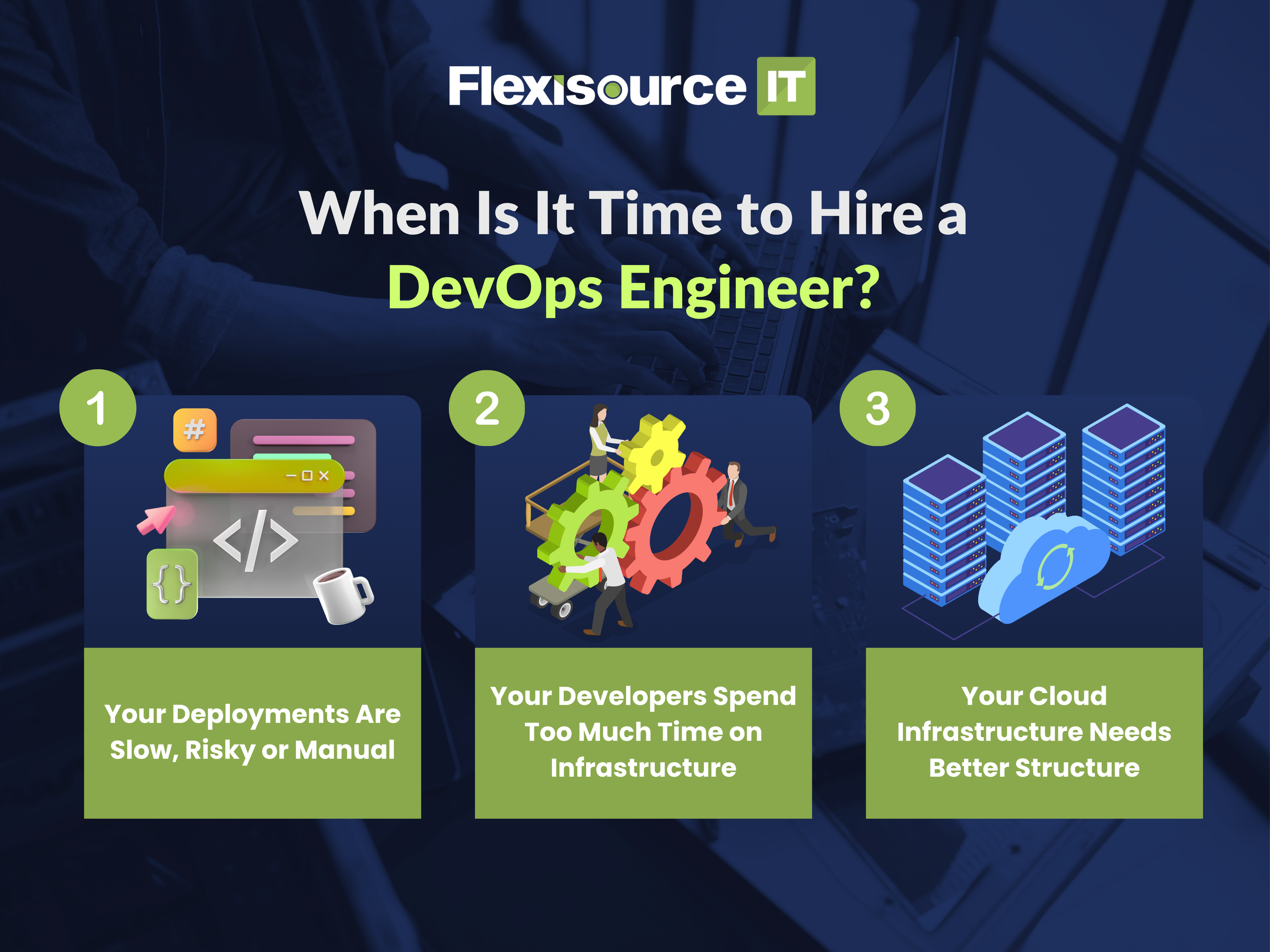
You should hire a DevOps Engineer first when your biggest challenge is getting software from development to production safely and consistently.
This is often the right move for startups, scaleups and SMEs that have developers building features but lack mature delivery systems. Without DevOps support, releases may depend on manual steps, informal processes or one overloaded technical lead who knows how everything works.
That creates risk. It also slows down the product roadmap.
Your Deployments Are Slow, Risky or Manual
Slow deployments are one of the clearest signs that your team needs DevOps support. If releasing a new feature requires too many manual steps, late-night coordination or repeated fixes, your delivery process is probably holding the team back.
A DevOps Engineer can help standardise and automate the release process through CI/CD and DevOps practices. This makes deployments more predictable and reduces the chance of human error.
The goal is not just to release faster. It is to release with more confidence.
Your Developers Spend Too Much Time on Infrastructure
Developers should not spend large parts of their week fixing environment issues, managing cloud settings or troubleshooting deployment problems that could be automated.
When this happens, your product team loses focus. Instead of building features, developers are pulled into infrastructure and support tasks.
Hiring a DevOps Engineer helps separate these responsibilities. Developers can focus more on product work, while DevOps improves the systems that support delivery.
For businesses searching for hire DevOps engineer Australia, this is often one of the strongest reasons to consider local or offshore support.
Your Cloud Infrastructure Needs Better Structure
As products grow, cloud infrastructure can become messy if no one owns it properly. Permissions, environments, deployment scripts, monitoring and configuration may all evolve in different directions.
A DevOps Engineer helps bring structure to this environment. They can support infrastructure automation, improve cloud setup, create repeatable processes and reduce reliance on manual fixes.
This is where DevOps staff augmentation can be useful. Instead of waiting months to find scarce local talent, Australian businesses can access an offshore DevOps engineer who works as part of their team and supports ongoing delivery improvements.
Read: Low-Code and No-Code: Accelerating Enterprise Development
When Should You Hire an SRE First?
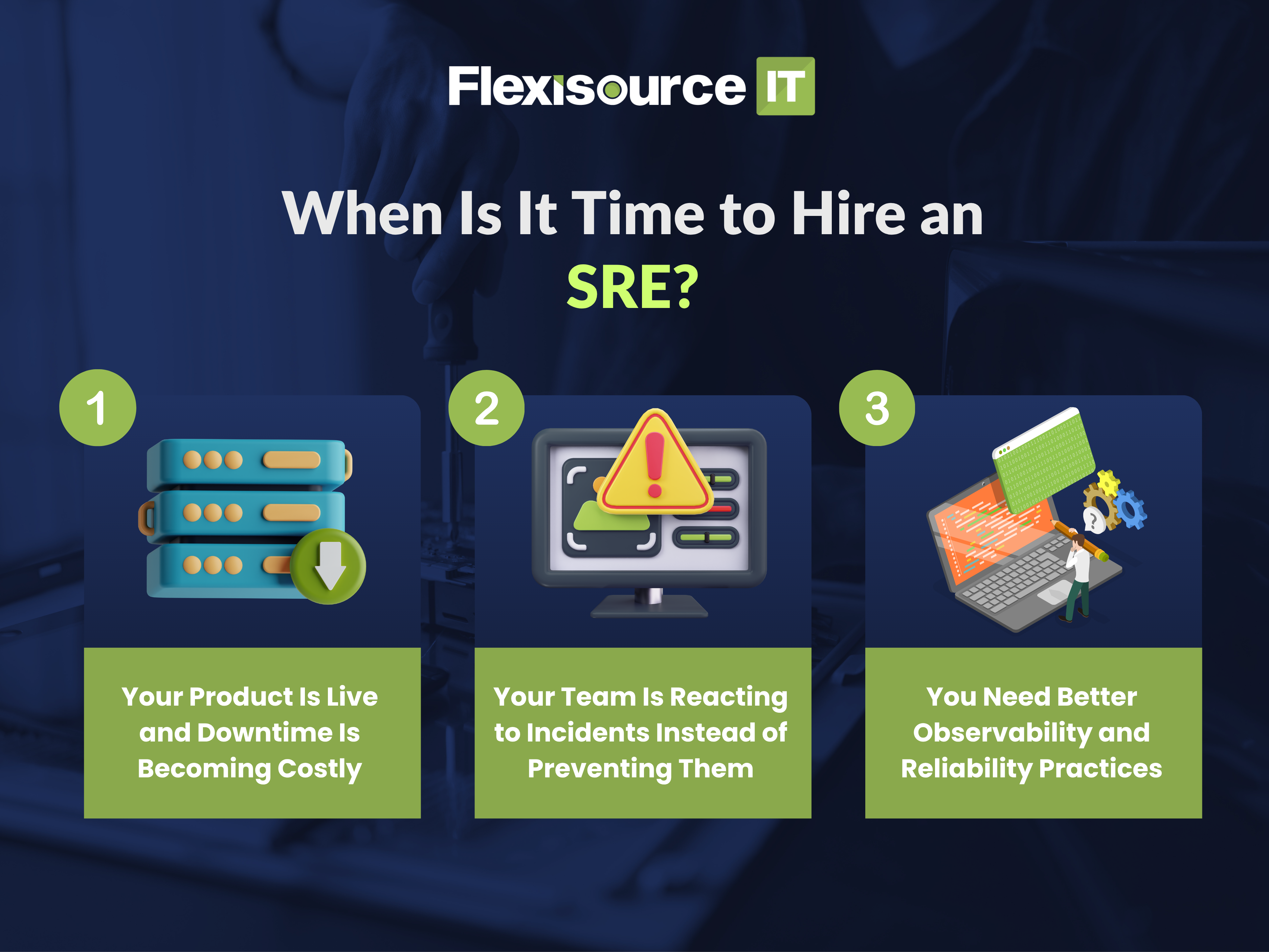
You should hire an SRE first when your biggest risk is no longer shipping software, but keeping that software stable in production.
This usually applies to businesses with live digital products, active users, revenue-generating platforms or internal systems that cannot afford repeated downtime. At this stage, reliability becomes more than a technical concern. It becomes a customer experience, revenue and business continuity issue.
Your Product Is Live and Downtime Is Becoming Costly
If downtime affects customers, sales, operations or trust, an SRE may be the more urgent hire.
A Site Reliability Engineer helps improve uptime, strengthen monitoring and reduce the impact of production issues. They look at how systems behave under real conditions and help the team prepare for traffic spikes, failures and performance problems.
For SaaS platforms, ecommerce businesses and digital service providers, this kind of reliability support can become essential as the product grows.
Your Team Is Reacting to Incidents Instead of Preventing Them
If your team is constantly responding to urgent issues, alerts or customer complaints, the problem may not be development speed. It may be weak reliability practices.
An SRE helps shift the team from reactive support to proactive prevention. This can include better incident response, root cause analysis, alert tuning, monitoring improvements and post-incident reviews.
The goal is not only to fix problems faster. It is to reduce how often the same problems happen.
You Need Better Observability and Reliability Practices
SREs help teams understand what is happening inside their systems. This is especially important when infrastructure becomes more complex and simple monitoring is no longer enough.
An SRE may improve:
- Logs, metrics and alerts
- System dashboards
- Performance monitoring
- Incident response workflows
- Reliability targets
- Capacity planning
- Cloud reliability engineering
If your team cannot clearly see why incidents happen or where systems are under pressure, SRE support should become a priority.
Can One Person Handle Both DevOps and SRE?
In smaller teams, one experienced engineer may cover parts of both DevOps and SRE. This can work when the product is still early, the infrastructure is manageable and the business needs broad technical support rather than deep specialisation.
However, this approach has limits.
DevOps and SRE may overlap, but they require different priorities. DevOps is focused on improving delivery systems. SRE is focused on production reliability. When one person is expected to own both, urgent production issues can easily interrupt delivery work, or release pressure can push reliability improvements to the side.
Startups May Need a Hybrid Role First
For startups, a hybrid DevOps/SRE role can be practical. The team may need someone who can build deployment pipelines, manage cloud infrastructure, improve monitoring and support production issues.
At this stage, the business may not have enough complexity to justify two separate roles. The more important goal is to bring structure to engineering operations before bottlenecks become harder to fix.
Scaling Products Usually Need Clearer Role Separation
As the product grows, the responsibilities usually become too much for one person.
A scaling business may need one person improving CI/CD, automation and developer workflows, while another focuses on uptime, incident response and reliability. This is where a more complete DevOps and SRE team becomes valuable.
The more users, systems and releases you manage, the more important it becomes to separate delivery speed from production reliability.
Best Hiring Approach for Startups, Scaleups and SMEs
There is no single answer to the DevOps vs. Site Reliability Engineering decision. The right first hire depends on your current bottleneck.
Startups: Hire for Delivery Stability First
Startups often benefit from hiring DevOps first. Early teams usually need repeatable deployments, cloud structure and better development workflows before they need a dedicated SRE.
If releases are slow, risky or too dependent on one senior developer, a dedicated DevOps engineer can help the team move faster with less friction.
Scaleups: Hire Based on the Bigger Bottleneck
Scaleups should look at where the business is losing the most time or taking the most risk.
If the team is struggling to ship features, hire DevOps first. If the product is live and reliability problems are affecting customers, hire Site Reliability Engineer support first.
Fast-growing products may need both. In that case, DevOps improves delivery, while SRE protects production stability.
SMEs: Consider Offshore Support to Fill Capability Gaps
For many Australian SMEs, hiring locally for DevOps or SRE can be difficult, especially when the business needs specialised support but does not yet need a full local team.
An offshore DevOps team can help businesses access technical capability without increasing local headcount too quickly. This can be especially useful for SMEs that need ongoing cloud, automation, deployment or reliability support but want a more flexible hiring model.
How Offshore Staff Augmentation Helps Build DevOps and SRE Capability
Offshore staff augmentation can help Australian businesses build DevOps and SRE capability faster and more cost-effectively.
Instead of waiting months to hire locally, businesses can add experienced offshore engineers who work with their internal team, follow their processes and support their existing technology environment.
Access Specialised Skills Without Increasing Local Headcount
DevOps and SRE roles require specific experience across cloud systems, automation, infrastructure, monitoring and production support. These skills can be hard to find locally, especially for growing businesses competing with larger companies.
DevOps staff augmentation gives Australian teams access to skilled engineers while keeping the internal team lean.
Build a Dedicated Offshore DevOps or SRE Team
A dedicated offshore DevOps or SRE team can support ongoing delivery and reliability work. This may include deployment automation, cloud management, monitoring improvements, incident support and infrastructure optimisation.
The key is integration. Offshore engineers should not work separately from the internal team. They should follow the same standards, tools and communication practices.
Read: Offshore Developers vs In-House Developers: Pros and Cons
Scale Support as Your Product Grows
A business may start with one offshore DevOps engineer, then add SRE support later as the product becomes more complex. This gives teams a practical way to grow capability based on real needs rather than hiring too much too soon.
Final Thoughts: Choose the Role That Solves Your Biggest Bottleneck
The DevOps vs. SRE decision should start with one question: is your team struggling more with software delivery or production reliability?
Hire a DevOps Engineer first if your releases are slow, manual or inconsistent. Hire an SRE first if downtime, incidents and poor observability are creating bigger risks. Consider both if your product is scaling quickly and needs stronger delivery and resilience at the same time.
Need help deciding which role to hire first? Contact Flexisource IT to build a dedicated offshore DevOps or SRE team that fits your Australian business.